
Industry News
Curation by industry experts
Hot Articles
Popular Tags
Thermal Insulation Cost: What Drives Payback in Retrofit Projects
Why thermal insulation cost only makes sense in real retrofit conditions
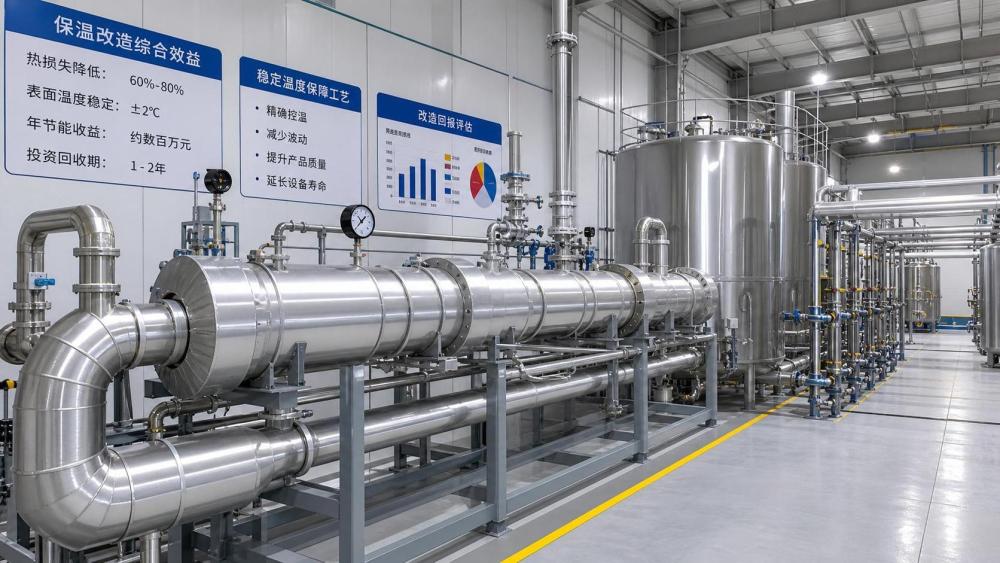
Thermal insulation cost becomes meaningful only when it is tied to actual operating conditions, not spreadsheet averages.
In retrofit work, payback often shifts because heat loss patterns, shutdown limits, moisture exposure, and installation access vary more than expected.
That matters across CHHS-linked sectors, from vacuum insulation equipment and stainless steel processing lines to sanitary water systems and light industrial storage facilities.
A plant handling insulated drinkware may chase stable process temperatures, while a bathroom hardware line may focus on hot water distribution efficiency.
Both projects discuss thermal insulation cost, but their return drivers are not the same.
The more practical question is not whether insulation is expensive.
It is which retrofit conditions allow insulation upgrades to recover capital faster, reduce maintenance losses, and support stable production quality.
Different facilities lose heat for different reasons
In actual applications, thermal insulation cost behaves differently in batch production, continuous processing, and utility distribution networks.
A molding workshop may face frequent temperature swings and short heating cycles.
A stainless steel vessel system may run for long hours with steady thermal loads.
A hot water loop serving sanitary fixtures may lose value through standby losses rather than process inefficiency.
This is why thermal insulation cost should be judged against heat profile, operating hours, exposed surface area, and access constraints.
When those factors are ignored, two similar-looking retrofit projects can produce very different payback periods.
Where payback usually moves faster
- Long operating hours with stable heat loads
- Equipment surfaces that are easy to wrap or panel
- High energy tariffs or fuel costs
- Processes where temperature stability affects product consistency
- Sites already planning maintenance shutdowns
These conditions often turn thermal insulation cost into a broader operational decision rather than a narrow material purchase.
Process lines usually justify thermal insulation cost differently than utility systems
Process equipment often delivers the clearest story when insulation affects both energy use and output stability.
In cookware forming, vessel heating, drying, or curing steps, uneven temperatures can create scrap, delays, or inconsistent finishing quality.
Here, thermal insulation cost is partly recovered through fewer process deviations, not just lower utility bills.
Utility systems are different.
Pipework serving wash zones, thermostatic shower testing, sanitary cleaning, or hot water circulation usually depends on distance, standby periods, and ambient conditions.
The return may still be strong, but the calculation needs a closer look at heat loss per meter, valve complexity, and service interruptions.
The table shows why thermal insulation cost should not be benchmarked with one standard payback assumption.
Material choice changes the economics more than many retrofit plans expect
One common mistake is comparing insulation materials only by thickness or quoted price.
In retrofit settings, thermal insulation cost also reflects cladding durability, moisture resistance, cleanability, mechanical protection, and replacement frequency.
That is especially relevant where CHHS-related production environments must balance heat efficiency with hygiene, corrosion control, and surface durability.
For example, insulation near stainless steel drinkware processing may need clean outer finishes and better condensation management.
Insulation around sanitary hot water systems may need stronger protection against wet conditions and frequent service access.
A cheaper material can raise lifetime thermal insulation cost if damage, contamination, or compression reduces performance within a short cycle.
Material screening points that affect payback
- Thermal conductivity under actual operating temperature
- Resistance to moisture, washdown, and corrosion exposure
- Compatibility with removable jackets or maintenance access
- Surface finish requirements for cleaner industrial environments
- Expected service life versus planned shutdown intervals
Installation complexity often decides whether thermal insulation cost pays back quickly
In many retrofits, material price is visible early, but installation difficulty is underestimated.
Valves, elbows, flanges, sensors, access doors, and irregular equipment shapes can expand labor hours far beyond initial estimates.
That is why thermal insulation cost should be modeled by installed condition, not by insulation roll or panel alone.
More complex layouts are common in sanitary hardware systems, smart water control assemblies, and mixed-use process areas.
In those settings, removable sections may cost more upfront but reduce future maintenance time.
The return improves when the retrofit avoids repeated stripping and reinstallation during inspections or repairs.
A practical review usually includes the following questions before approving thermal insulation cost.
- Can the work be completed during planned downtime?
- How many fittings interrupt straight runs?
- Will maintenance teams need recurring access?
- Does the insulation create clearance or safety issues?
- Will damaged sections be easy to replace selectively?
Where retrofit teams misread thermal insulation cost
The most frequent misread is treating similar temperature systems as identical investment cases.
A hot pipe in a dry utility corridor behaves differently from a hot pipe above washdown equipment.
A heated tank with constant duty behaves differently from one used only for short production windows.
Another oversight is focusing only on purchase cost.
If maintenance removal, damaged cladding, trapped moisture, or hygiene compliance issues appear later, the original thermal insulation cost estimate stops being useful.
There is also a planning gap around measurement.
Without baseline surface temperatures, fuel consumption trends, or operating-hour data, payback claims often rely on generic assumptions.
That weakens retrofit prioritization, especially when several upgrades compete for the same capital budget.
A more reliable way to compare scenarios before approving the budget
The better approach is to compare thermal insulation cost across a few clearly defined site conditions rather than one average case.
One scenario can use current operating hours.
Another can test higher production utilization.
A third can include expected maintenance removal or moisture exposure penalties.
This reveals whether payback is robust or only attractive under perfect conditions.
Useful comparison points before final selection
This kind of comparison is especially useful in mixed industrial portfolios where kitchenware, sanitary hardware, plastics, and thermal products share utility infrastructure.
What to confirm next before moving from estimate to retrofit decision
A sound retrofit decision starts with a tighter view of where heat loss actually carries economic weight.
That may be a process vessel, a recirculating hot water line, a heated enclosure, or a batch zone with unstable cycles.
From there, thermal insulation cost should be checked against installation access, lifecycle maintenance, material suitability, and realistic operating schedules.
The most reliable next step is to sort retrofit targets by heat intensity, runtime, geometry complexity, and service environment.
Then compare not only upfront thermal insulation cost, but also retained performance over time.
That approach produces clearer payback expectations and better retrofit sequencing, especially where energy, hygiene, durability, and process consistency all matter at once.
Recommended News