
Industry News
Curation by industry experts
Hot Articles
Popular Tags
Pet Care Private Label: Cost, MOQ, and Margin Basics
Why do cost, MOQ, and margin decide most pet care private label outcomes?
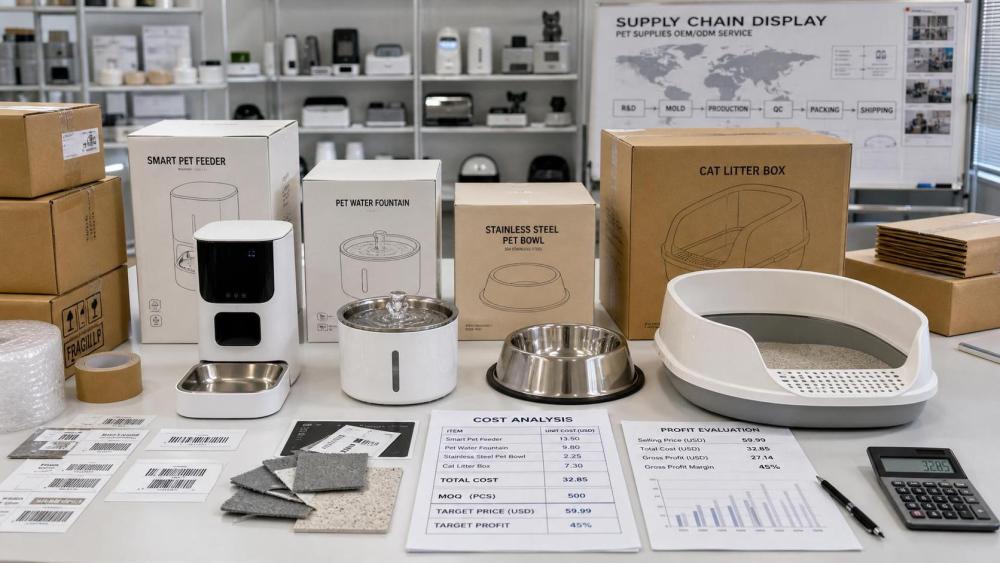
Pet care private label projects usually look simple at first. A feeder, a fountain, a litter box, and a logo change can seem easy to compare.
In practice, the commercial result depends on three linked numbers. Those numbers are landed cost, minimum order quantity, and realistic gross margin.
That is why pet care private label sourcing needs more than a unit quote. A lower factory price can still create slower inventory turns or weaker category profit.
A useful starting point is to treat pet products like other light industrial categories. Material choice, tooling, electronics, packaging, and compliance all shape final economics.
This is also where CHHS-style market intelligence becomes helpful. The same sourcing logic used in kitchenware, molded plastics, drinkware, and smart hardware often applies here.
So the real question is not only, “What does this product cost?” It is, “What cost structure supports the volume, positioning, and margin target?”
What usually makes up the cost of a pet care private label product?
The cost base changes by product type. A silicone lick mat is very different from a smart pet feeder with sensors, motors, PCBA, and app pairing.
Still, most pet care private label quotes include the same building blocks. Understanding them helps separate a complete quote from a misleading low headline number.
- Raw materials, such as food-contact PP, ABS, stainless steel, silicone, filters, or Tritan parts.
- Processing cost, including injection molding, assembly, welding, polishing, leak testing, or electrical calibration.
- Tooling amortization, especially when private molds, custom housings, or unique packaging inserts are involved.
- Compliance and testing, such as food-contact checks, EMC, battery transport rules, or region-specific labeling.
- Packaging, manuals, master cartons, barcode labels, and retailer-specific drop or shelf requirements.
For smart pet devices, hidden cost often sits in firmware stability, anti-jam design, water pump reliability, and returns exposure. These items do not always appear clearly on the first quote.
For simpler consumable or molded items, cost pressure usually comes from resin grade, wall thickness, cavity count, decoration, and carton efficiency.
A practical review method is to ask whether the quote reflects product reality. If the supplier claims stainless steel, what grade is used? If it is food-contact, what standard applies?
This type of disciplined cost reading is familiar across CHHS categories. It mirrors how teams evaluate cookware alloys, insulated bottle liners, or molded storage products.
How high is MOQ in pet care private label, and when is it worth negotiating?
MOQ is rarely just a sales policy. It usually reflects mold utilization, procurement batches, assembly efficiency, and packaging setup economics.
More common MOQ patterns look like this:
Negotiation is possible, but the best leverage is structure, not pressure. Instead of asking for a random lower MOQ, it is better to simplify colorways, share components, or use stock packaging first.
In actual sourcing, many pet care private label launches start with a semi-custom path. The factory keeps the standard mold, while branding, carton design, and accessory bundles change.
That approach lowers risk and protects cash. It also gives cleaner data for a second order, when true demand becomes visible.
Where does margin really come from in pet care private label?
Margin does not come from factory price alone. It comes from the spread between total landed cost and what the market accepts for that feature set.
This matters because pet care private label products often compete in crowded online and offline channels. Similar-looking items can have very different return rates and reorder performance.
The stronger margin drivers are usually less obvious:
- Feature relevance. Quiet pumps, anti-clog flow, portion accuracy, or easier cleaning can support better pricing.
- Material confidence. Food-contact plastics, stainless steel grade clarity, and safer cable design reduce objection and refund risk.
- Packaging efficiency. Better carton density cuts freight and protects margin without changing shelf price.
- Accessory strategy. Filters, trays, replacement parts, or bundled consumables can improve total category return.
- Operational reliability. Fewer failures often matter more than a slightly lower ex-works quote.
A cheap feeder that jams creates hidden margin loss. Customer support, returns, replacement freight, and review damage can wipe out the apparent savings.
That is why margin analysis should include expected defect rate, accessory attach rate, and product lifespan. The best pet care private label program is often the one with stable repeat sales.
Which products are easier for testing a pet care private label launch?
Not every category carries the same entry risk. Some products allow faster testing with lower compliance and tooling pressure.
A sensible first wave often includes non-powered items or low-complexity products. Bowls, mats, storage bins, grooming tools, or simple fountains are easier to benchmark.
Smart devices can still be attractive, but they need stricter screening. Firmware support, spare parts, pump life, battery handling, and certification status must be reviewed early.
A quick decision table helps frame that trade-off:
This staged logic matches broader CHHS sourcing practice. Many categories begin with standard platforms, then move into deeper customization after market proof appears.
What mistakes distort the cost and margin picture most often?
One common mistake is comparing quotes with different assumptions. One factory may include gift box printing, while another prices only bulk-packed goods.
Another issue is ignoring lifecycle cost. Pet care private label products with replaceable parts need a plan for filters, pumps, trays, adapters, or app updates.
There is also a frequent compliance gap. If the product touches water or food, material claims and test evidence matter. If it is powered, electrical and transport rules matter too.
The following checklist usually catches the biggest blind spots:
- Confirm whether tooling, packaging plates, and barcode work are included or separate.
- Check if MOQ applies per SKU, per color, or per shipment mix.
- Ask for defect allowance, warranty policy, and spare part availability.
- Review compliance files before artwork approval and mass production booking.
- Estimate landed cost, not just ex-works cost, especially for bulky items.
These checks sound basic, but they often decide whether a pet care private label order scales smoothly or stalls after the first shipment.
How should the next sourcing step be structured?
A strong next step is to define the product family before requesting wide quotes. Separate low-complexity items from smart devices, and separate price-entry goals from premium targets.
Then build one comparison sheet around pet care private label economics. Include unit price, MOQ, tooling, packaging, compliance status, warranty terms, and estimated landed margin.
In real buying cycles, clarity beats speed. A supplier with a slightly higher quote but stronger process control may produce the better commercial result.
The main idea is simple. Pet care private label works best when cost, MOQ, and margin are read together, not in isolation.
If the category is new, begin with fewer SKUs, cleaner assumptions, and realistic reorder scenarios. If the category already exists, compare where margin is earned or lost today.
That approach creates a better base for supplier evaluation, product comparison, and private-label planning across smart pet technology and adjacent CHHS sourcing categories.
Recommended News