
Industry News
Curation by industry experts
Hot Articles
Popular Tags
How to Compare Temperature Control Valves for Stable Flow
Stable flow is one of the hardest performance targets in thermal fluid systems because temperature and pressure rarely stay constant at the same time. When comparing temperature control valves, the real question is not only how quickly a valve reacts, but how consistently it maintains outlet conditions under changing demand, supply pressure, and media temperature.
That matters across CHHS-relevant product categories, especially smart bathroom hardware, sanitary fittings, thermostatic shower systems, heated water delivery assemblies, and other household fluid-control products where comfort, water efficiency, and product reliability intersect. A valve that looks similar on paper can behave very differently in installation, sourcing, and long-cycle use.
For that reason, a sound comparison should connect control mechanism, material choice, pressure response, certification context, and manufacturing consistency. Looking at only one parameter often leads to an incomplete decision.
What temperature control valves are really being compared
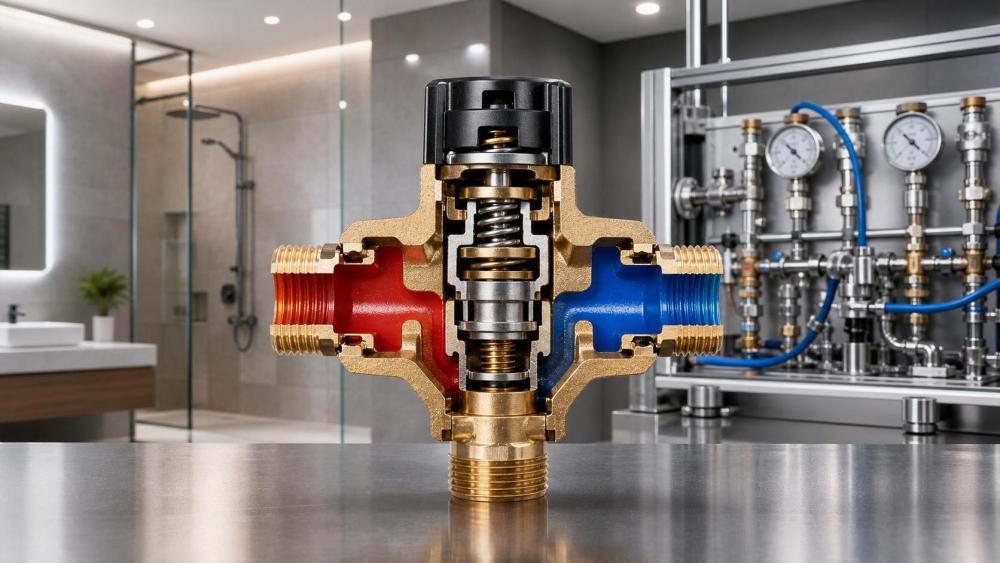
In practical terms, temperature control valves regulate fluid temperature by adjusting the mix of hot and cold streams or by modulating flow through a heat-transfer loop. In sanitary and household hardware, this often means thermostatic mixing valves, temperature-limiting valves, or cartridge-based control assemblies.
The comparison becomes more complex when products use different sensing principles. Some rely on wax elements. Others use bimetal mechanisms, liquid-filled sensors, or shape-memory materials. Each approach affects response speed, repeatability, drift, and service life.
A stable-flow evaluation therefore should not group all temperature control valves together as if they solve the same problem in the same way. Their operating logic directly affects user experience and system stability.
Why stable flow has become a stronger selection factor
In older comparisons, temperature accuracy was often the headline metric. Today, stable flow deserves equal attention. Household and light industrial systems now face stricter expectations around comfort, scald prevention, water conservation, and consistent performance across mixed supply conditions.
This is especially visible in thermostatic shower valves and smart sanitary hardware. Users expect a comfortable outlet temperature without noticeable fluctuation when another fixture opens, inlet pressure shifts, or water heater output changes.
From a sourcing and product development perspective, unstable flow can also trigger complaints that appear unrelated at first. Noise, slow response, temperature overshoot, weak discharge, and inconsistent feel at the handle may all trace back to valve behavior.
That is why CHHS-style product intelligence increasingly connects fluid control performance with broader concerns such as system integration, component durability, and export readiness.
The core comparison points that reveal actual performance
When reviewing temperature control valves, several metrics deserve to be assessed together rather than in isolation.
Control accuracy and thermal response
Setpoint accuracy shows how closely the outlet temperature matches the target. Response time shows how quickly the valve corrects after a disturbance. Repeatability shows whether that behavior remains consistent over many cycles.
A valve with fast initial response may still deliver poor stability if it oscillates around the target. For shower and sanitary systems, smooth correction is often more valuable than aggressive correction.
Flow coefficient and pressure sensitivity
Temperature control valves can maintain temperature yet still create disappointing flow performance if the internal path is too restrictive. Kv or Cv values help compare capacity, but they should be read with the intended operating pressure range.
Pressure imbalance matters as much as rated flow. A valve designed for balanced supplies may struggle in buildings where hot and cold pressure differ significantly. In such cases, flow stability and temperature stability can both degrade.
Material compatibility and media conditions
Brass grade, stainless components, elastomer quality, and cartridge sealing materials affect corrosion resistance and dimensional stability. In hard-water regions, scale tolerance becomes a major differentiator.
If the valve will be used in sanitary applications, material quality also connects with compliance review, drinking water contact expectations, and long-term maintenance risk.
Valve type should match the application, not just the specification sheet
A common sourcing mistake is comparing temperature control valves only by nominal size, pressure rating, and advertised temperature range. That misses the installation context.
For domestic shower systems, thermostatic mixing valves are usually judged on comfort, anti-scald behavior, and flow consistency during rapid demand changes. For basin, bidet, or compact sanitary fittings, package size, cartridge replacement logic, and low-flow sensitivity may matter more.
In circulation or appliance-adjacent systems, the focus may shift toward long-cycle stability, compatibility with heated water components, and tolerance for repeated thermal cycling.
In other words, the best temperature control valves are not universally the most precise ones. They are the valves that maintain acceptable thermal and hydraulic behavior within the real operating envelope.
What technical reviews should look for beyond catalog claims
Published data often highlights ideal laboratory conditions. Stable flow problems usually appear outside those conditions. A stronger review process checks how the valve behaves when inlet temperature shifts, cold-water pressure drops, or scale begins to build.
- Verify the tested inlet pressure range, not only the maximum pressure rating.
- Check whether flow data is measured with or without downstream accessories.
- Review shutoff logic for hot or cold supply failure.
- Compare cycle-life testing and post-test temperature deviation.
- Look for evidence of anti-scale design in cartridges and passages.
- Confirm material declarations when drinking water or sanitary compliance matters.
This approach is useful in CHHS-linked supply chains because component quality, assembly consistency, and compliance documentation often vary between visually similar products.
Manufacturing consistency can matter as much as valve design
Even well-designed temperature control valves can show unstable performance if cartridge tolerances drift, spring characteristics vary, or internal passages are not machined consistently. This is where supplier evaluation becomes part of technical comparison.
For export-facing sanitary hardware, it helps to review process control around casting, machining, plating, cartridge assembly, leak testing, and thermal calibration. A reliable supplier should also explain how batch variation is monitored.
That is one reason platforms like CHHS are useful in practice. Product comparison becomes more credible when it is linked with manufacturing visibility, compliance understanding, and category-specific performance language rather than generic marketing claims.
A practical framework for comparing temperature control valves
A workable assessment can start with five filters.
- Define the real operating window for temperature, pressure, and expected flow.
- Match valve architecture to the application rather than choosing by price tier alone.
- Review dynamic performance under disturbance, not only steady-state ratings.
- Check material and cartridge durability against water quality conditions.
- Compare supplier process control, test evidence, and replacement support.
This method creates a more realistic shortlist and reduces the risk of selecting temperature control valves that look compliant but perform poorly after installation.
Where to go next with the comparison
The next step is usually to turn broad requirements into a comparison matrix. Include target outlet temperature, acceptable fluctuation band, inlet pressure imbalance, minimum flow threshold, material expectations, and safety requirements.
From there, compare temperature control valves using both catalog data and evidence from testing, field feedback, and production consistency. That makes it easier to distinguish between products that meet a specification and products that hold stable flow under real operating conditions.
When the evaluation is tied to application context instead of isolated claims, sourcing and engineering decisions become clearer, more defensible, and more useful over the product lifecycle.
Recommended News