
Industry News
Curation by industry experts
Hot Articles
Popular Tags
Thermal Retention Technology: What Actually Keeps Heat Longer?
Why does thermal retention technology matter beyond simple heat claims?
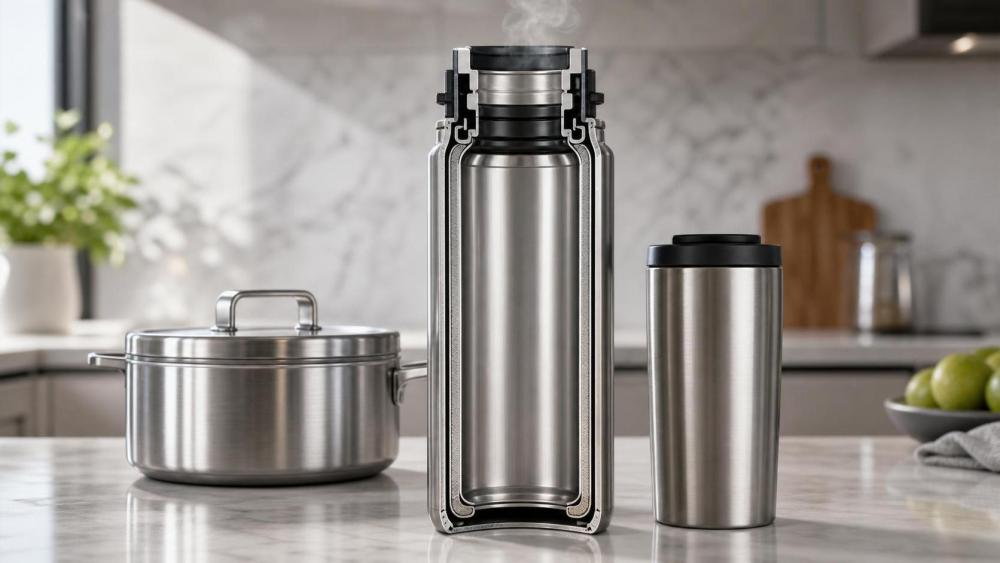
Thermal retention technology affects daily products more than many labels suggest.
It shapes how insulated bottles hold coffee temperature, how cookware stays warm at the table, and how heated household systems reduce rapid heat loss.
People often ask a simple question: what actually keeps heat longer?
The answer is rarely one material alone.
In real use, thermal retention technology depends on structure, wall design, sealing, surface treatment, air gaps, and how the product is used.
That is why two stainless steel mugs can perform very differently, even when both advertise insulation.
Within consumer housewares and hardware systems, this topic also connects to manufacturing quality, material safety, and product positioning.
CHHS often frames these questions through practical comparison.
Instead of repeating broad marketing claims, it looks at vacuum insulation, stainless steel grades, molded parts, sealing systems, and performance differences across categories.
That makes thermal retention technology easier to evaluate in sourcing, development, and product research.
So what actually keeps heat longer inside a product?
Heat escapes in three main ways: conduction, convection, and radiation.
Good thermal retention technology slows all three, not just one.
A vacuum-insulated bottle is the clearest example.
The vacuum layer reduces heat transfer because there is very little material or air to carry heat outward.
If the inner wall also has a reflective coating, radiant heat loss drops as well.
The lid then becomes critical.
Even strong thermal retention technology can fail when heat escapes through a weak plastic cap, poor gasket, or drinking spout.
Cookware works differently.
A tri-ply pan does not usually trap heat like a thermos.
Instead, it stores and distributes heat through layered metals.
Heavier construction can help retain serving temperature longer after the heat source is removed.
In plastic household products, thermal retention technology usually appears in food containers, drinkware shells, or smart appliances with insulated chambers.
Here, foam layers, double walls, and controlled part thickness often matter more than metal mass.
Simple claims like “double wall” are not enough.
The performance depends on whether the cavity contains vacuum, air, foam, or only decorative spacing.
Which materials make the biggest difference in thermal retention technology?
Material selection matters, but it has to be read together with design.
Stainless steel is widely used because it is durable, food-safe, and compatible with vacuum structures.
Grade differences matter more for corrosion resistance than for insulation alone.
For example, 316 stainless steel is often chosen for drinkware exposed to salt, acids, or demanding beverage use.
The longer heat retention usually comes from the insulation build, not from 316 by itself.
Copper plating on the liner is another common discussion point.
In vacuum bottles, a copper-coated layer can reflect radiant heat and improve thermal retention technology measurably.
It is useful, but not magical.
Poor sealing or weak vacuum quality can cancel the gain.
Plastics also play a role.
PP, Tritan, silicone, and engineering plastics influence lid temperature, handling comfort, and leakage points.
They are usually support materials in thermal retention technology, not the main heat barrier.
The practical takeaway is straightforward: material quality matters, but structure decides the outcome.
A quick comparison helps clarify the usual confusion
This kind of breakdown is often more useful than a single advertised hour rating.
Why do similar products show very different heat retention times?
Because testing conditions are rarely identical.
Thermal retention technology looks strong in controlled tests, but daily use introduces many variables.
The starting temperature matters.
So does fill volume, room temperature, lid opening frequency, and whether the container was preheated.
Shape also changes results.
A narrow bottle opening loses heat more slowly than a wide food jar.
A large pan with a thin lid cools faster than a smaller vessel with denser construction.
Manufacturing consistency is another reason.
In insulated drinkware, tiny differences in vacuum integrity, weld quality, or neck design can shift performance noticeably.
In molded products, wall thickness variation and assembly tolerance can create unintended heat bridges.
This is why practical industry analysis often pairs thermal retention technology claims with process details.
Without that context, comparisons become superficial.
Where is thermal retention technology most useful in everyday housewares?
The obvious category is insulated drinkware.
Bottles, travel mugs, flasks, and food jars depend directly on thermal retention technology for user satisfaction.
The difference shows up in commuting, outdoor use, office carry, and long-duration hydration.
Cookware is the next layer.
Here, thermal retention technology is less about storing heat for many hours and more about stable cooking response.
Tri-ply pans, stainless steel pots, and multi-layer bases use heat retention to support even cooking and serving comfort.
Smart household products can also benefit.
Pet water systems, warming modules, sanitary hardware, or appliance-related containers may use insulation to manage energy loss and surface safety.
In these cases, thermal retention technology supports comfort, efficiency, and system stability rather than only beverage temperature.
That broader view fits the CHHS approach well.
The same technical logic can cross from drinkware to cookware, plastic components, and smart hardware products.
What are the most common mistakes when judging thermal retention technology?
One mistake is trusting a single temperature claim without test conditions.
“Keeps hot for 12 hours” sounds precise, but the real meaning depends on starting temperature and final threshold.
Another mistake is focusing only on body material.
Many weak points sit in lids, seals, handles, and openings.
A third mistake is confusing heat capacity with insulation.
Heavy cookware may stay warm because it stores heat.
That is different from a vacuum bottle, which mainly slows heat escape.
It also helps to watch for these checkpoints:
- Whether the product uses true vacuum insulation or only double-wall construction.
- Whether sealing parts are food-contact safe and durable under repeated use.
- Whether the thermal retention technology affects cleaning difficulty or maintenance.
- Whether the stated performance aligns with product size, opening diameter, and use case.
These checks usually reveal more than a polished retail description.
How should thermal retention technology be compared before making a decision?
A useful comparison starts with the use scenario, not the headline claim.
Ask whether the product needs hour-by-hour heat holding, short-term serving warmth, user-safe exterior temperature, or energy efficiency.
Then compare the technical details behind the promise.
This is where a platform like CHHS becomes relevant.
Thermal retention technology is easier to judge when it is linked with stainless steel processing, food-contact standards, molded part quality, and actual category use.
That broader context helps separate engineering value from simple label language.
What should be the next step if you want a clearer answer?
Start by defining what “keeps heat longer” means in the actual application.
For a bottle, it may mean drinkable warmth after six hours.
For cookware, it may mean slower temperature drop during serving.
For household hardware or smart products, it may mean lower energy loss or safer user contact.
From there, compare structure, materials, sealing, and test conditions together.
The strongest thermal retention technology is rarely just a premium material or a thicker wall.
It is usually the result of disciplined design choices working as one system.
A careful review of insulation method, heat-loss points, compliance needs, and category-specific performance will produce a more reliable conclusion.
That is the most practical way to understand what actually keeps heat longer.
Recommended News