
Industry News
Curation by industry experts
Hot Articles
Popular Tags
How vacuum flask tooling affects insulation consistency and cycle time
Vacuum flask tooling often gets treated as a back-end manufacturing detail, but in practice it is one of the main reasons insulated bottles either perform consistently or drift from lot to lot. For technical evaluators, the real question is not whether a flask can pass an initial insulation test. It is whether the tooling can keep wall geometry, neck alignment, vacuum chamber quality, and cycle stability within control once production moves from sample trials to full-scale output.
That matters because insulated drinkware is a system, not a single part. The bottle body, inner liner, sealing region, neck finish, and outer shell all interact. If the mold or forming tool introduces variation early in the process, later steps such as evacuation, sealing, and finishing have less room to compensate. The result is usually familiar: inconsistent thermal retention, higher reject rates, unstable cycle time, and more frequent process adjustments.
In insulated bottle manufacturing, tooling quality influences two performance targets at the same time. It affects insulation consistency by controlling dimensional repeatability and wall thickness uniformity. It affects cycle time by controlling how quickly the part can be formed, cooled, stripped, and returned to the next shot. A tool that is optimized only for throughput may create thin spots, uneven shrinkage, or neck distortion. A tool that is overbuilt for precision may produce excellent parts but slow production enough to hurt unit economics. The best tooling balances both.
Why tooling has a direct impact on insulation consistency
Vacuum insulation depends on maintaining a stable evacuated gap between the inner and outer walls. That gap is sensitive to small variations in geometry. If the wall is not evenly formed, if concentricity drifts, or if the neck area deforms after cooling, the effective vacuum space can become uneven. Even when the bottle still looks acceptable externally, performance may vary enough to show up in heat loss testing.
Tooling precision becomes especially important in three areas. The first is wall uniformity. Uneven wall thickness changes heat flow paths and can create local stress during cooling. The second is dimensional stability at the sealing interface. If the neck finish is not tightly controlled, sealing quality becomes inconsistent, and micro-leak risk rises. The third is alignment between forming, trimming, and sealing operations. When tooling tolerance stacks are loose, the bottle may still be manufacturable, but thermal consistency becomes harder to guarantee.
For stainless steel vacuum flasks, these issues are amplified by material behavior during deep drawing, spinning, welding, or neck forming. Stainless steel does not forgive tooling drift. A small mismatch in die wear or forming pressure can translate into nonuniform springback, which then affects downstream vacuum integrity. Technical evaluators should pay attention not only to nominal dimensions, but also to the tool’s ability to hold those dimensions after repeated cycles.
In practice, many insulation complaints are not caused by the vacuum process alone. They begin with tooling-induced variation that narrows the process window. Once the window is narrow, the line becomes more sensitive to operator adjustment, temperature fluctuation, and material batch differences.
How tooling design affects cycle time
Cycle time is often discussed as a productivity metric, but for vacuum flask tooling it is also a quality metric. Poor tool thermal management creates longer cooling requirements, and that can distort output planning. If a part is ejected before it reaches stable temperature, deformation risk rises. If the tool is overcooled to protect shape, the cycle becomes unnecessarily long.
The main cycle-time drivers are heat transfer, release behavior, and part handling. Cooling channel design determines how fast heat can be removed from the formed body. Venting and surface finish affect how easily the part releases from the cavity. Tool geometry affects whether automated unloading can run smoothly without manual intervention. In a mature line, these factors are closely linked: a tool that releases cleanly usually supports faster cycling, while a tool with poor release characteristics often forces conservative cycle settings.
Tooling also influences downstream time loss. A mold that produces inconsistent necks or local distortion may not fail immediately at forming, but it can slow trimming, welding, leak testing, or assembly. In other words, the shortest forming cycle is not always the fastest plant-level cycle. Technical evaluators should assess total process time, not only tool open-close time.
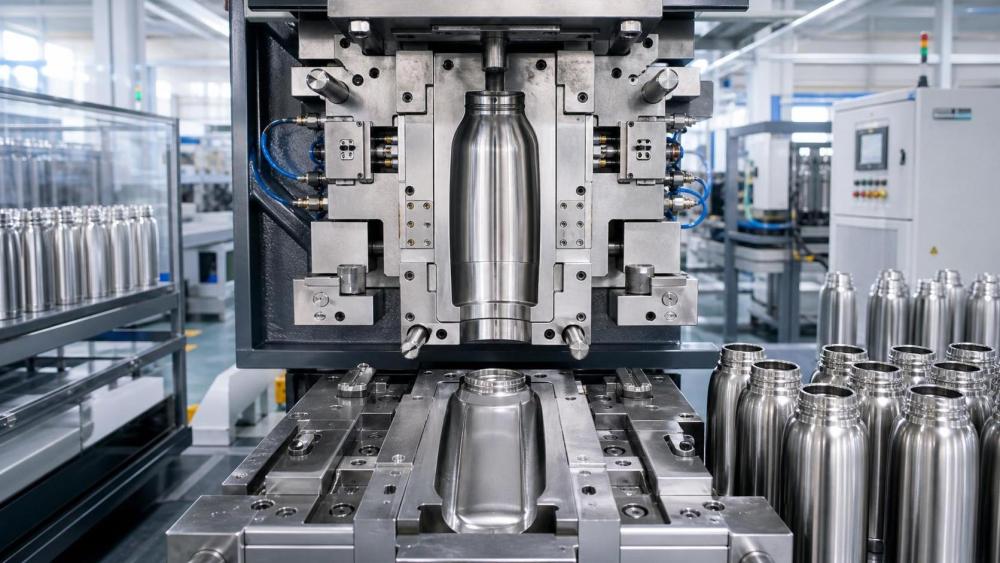
One common mistake is to judge tooling by early pilot output alone. A small trial may show acceptable speed because the tool is new, clean, and carefully attended. After repeated runs, however, wear, fouling, vent blockage, and thermal imbalance begin to change the cycle profile. That is why tooling evaluation should include durability under sustained production conditions, not just initial part approval.
The link between tooling precision and vacuum integrity
Vacuum integrity is often associated with sealing technology, but tooling quality sets the foundation. The inner and outer shells must be formed with enough positional accuracy that the evacuation and sealing steps can work reliably. If the alignment is off, the vacuum space may be uneven or too narrow in certain regions, which complicates evacuation and increases the chance of residual stress after sealing.
This becomes more important when manufacturers try to improve thermal performance through thinner walls, lighter designs, or more aggressive styling. Lightweighting reduces material margin, so the tooling has to carry more of the burden for dimensional control. In that situation, the process is less forgiving of tool wear and machine variation. A design that looks efficient on paper can become unstable in production if the tooling cannot hold repeatability across long runs.
From a technical evaluation standpoint, the key indicators are not only first-pass yield and insulation test results. Equally important are cavity-to-cavity variation, part-to-part concentricity, sealing face flatness, and deformation after demolding. These are the hidden variables that determine whether a bottle maintains performance across an entire order, rather than only in lab samples.
What technical evaluators should inspect in vacuum flask tooling
A proper assessment starts with tolerance control. The tool should be capable of holding critical dimensions related to wall thickness, neck geometry, and sealing interfaces within a stable process window. If the tolerance stack is too loose, production can still run, but process capability will be fragile.
Surface finish is another practical factor. In forming and molding operations, rough or inconsistent surfaces increase release resistance, raise scrap risk, and extend cleaning intervals. That may seem secondary, but in high-volume drinkware production it directly affects uptime and cycle repeatability. Tooling that wears unevenly tends to create a slow decline in quality before it triggers visible failure.
Cooling design deserves close attention. Inconsistent cooling across the cavity leads to uneven shrinkage and local warpage. For vacuum flask components, warpage is not just cosmetic; it can affect how the inner and outer structures align and how the final sealing system performs. A well-designed cooling layout shortens cycle time without forcing unstable ejection conditions.
Maintenance accessibility is also part of technical quality. If a tool is difficult to service, small defects remain in the system longer. That leads to creeping variation in insulation performance. A production-ready tool should allow routine cleaning, wear inspection, vent maintenance, and component replacement without extended downtime.
Where tooling decisions often go wrong
One recurring error is over-optimizing for output speed during the prototype stage. A team may accept a faster cycle even though the tool is running close to its dimensional limit. Once full production starts, the line becomes more sensitive to material batch differences and ambient conditions. Insulation inconsistency then appears later and is harder to trace back to tooling.
Another problem is assuming that a successful sample means the tool is production-ready. In vacuum flask manufacturing, sample success can hide marginal cooling, insufficient venting, or unstable ejector behavior. These weaknesses show up only after repeated runs.
A third issue is underestimating the effect of wear. Stainless steel forming, trimming, and repeated thermal cycling will gradually change tool behavior. If wear compensation is not built into the maintenance plan, dimensional drift becomes inevitable. Technical evaluators should ask how the supplier monitors tool degradation and how often critical surfaces are requalified.
There is also a tendency to separate insulation performance from manufacturing capability. In reality they are tightly connected. A bottle that performs well in a single test but cannot be reproduced consistently is not a strong product. For buyers and technical teams, repeatability is often more valuable than peak performance.
How to evaluate whether the tooling is good enough for production
The most useful test is consistency across runs. Look at insulation results from multiple cavities, multiple shifts, and multiple material lots. If performance drifts significantly, the issue may not be the vacuum process itself but the tool’s inability to hold geometry consistently.
It is also worth reviewing how the supplier measures and controls critical dimensions. Reliable manufacturers usually track concentricity, wall thickness variation, neck finish accuracy, and deformation after cooling. If these are not monitored, the risk of hidden variation is high.
Production stability should be checked alongside cycle stability. A tool that starts well but requires frequent adjustment is not stable, even if the average output looks acceptable. Technical evaluators should ask how often the line needs manual correction, how much scrap appears after steady-state operation, and whether the cycle time remains consistent after prolonged production.
For sourcing decisions, tooling readiness is often a better indicator than marketing claims about insulation duration. The real question is whether the manufacturer has proven that the tool can support the claimed performance at volume, without sacrificing throughput or increasing defect risk.
What this means for manufacturers and buyers
For manufacturers, vacuum flask tooling is a leverage point. Better tool design can reduce scrap, shorten cooling time, improve vacuum consistency, and stabilize downstream assembly. That improves both product quality and plant efficiency.
For buyers and technical evaluators, the tooling review is where many hidden risks can be identified early. A supplier may present strong finished samples, but if the tooling cannot maintain those results over time, the commercial risk remains. The most reliable partners are usually the ones that can explain not only insulation performance, but how tooling precision, maintenance control, and cycle optimization support that performance under real production pressure.
In the insulated drinkware market, thermal claims are easy to advertise and hard to sustain. Tooling is one of the few places where consistency can be engineered rather than hoped for. That is why it deserves a more serious review than it usually receives.
Recommended News