
Industry News
Curation by industry experts
Hot Articles
Popular Tags
Kitchenware UK: 2026 Retail Entry Costs and Margin Risks
Kitchenware UK: 2026 Retail Entry Costs and Margin Risks
For business evaluation teams, entering the kitchenware UK market in 2026 means weighing store access costs against margin pressure, compliance expense, and category competition.
This introduction outlines the key cost drivers, retail gatekeeping factors, and pricing risks shaping profitability.
It helps buyers, suppliers, and investors assess whether kitchenware UK expansion can deliver sustainable returns.
Why kitchenware UK still attracts retail investment
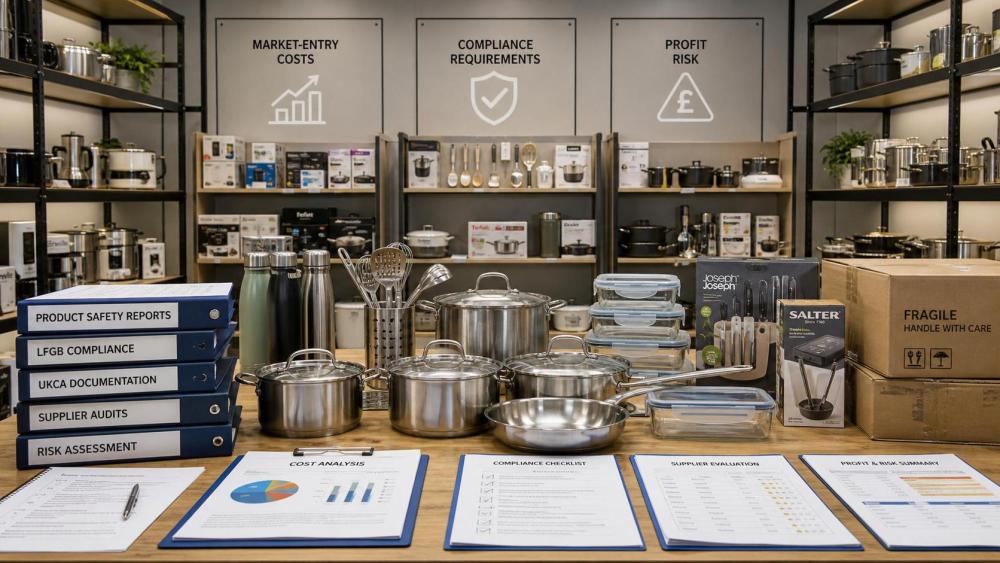
The kitchenware UK market remains attractive because household replacement demand is steady, even when consumer confidence feels uneven.
People may delay furniture or electronics, but they still replace pans, storage sets, bottles, knives, and cooking tools.
That creates recurring volume, especially in mid-price retail channels and online-led private label programs.
From a sourcing perspective, kitchenware UK also benefits from wide category breadth.
A retailer can balance cookware, drinkware, food storage, and kitchen tools inside one buying cycle.
That matters because category mix can offset margin pressure in one segment with stronger turns in another.
Still, attractive demand does not mean easy entry.
The real challenge in kitchenware UK is not whether products can sell.
It is whether retail entry costs and margin leakage leave enough profit after launch.
The real cost of entering kitchenware UK retail in 2026
In practical terms, kitchenware UK market entry starts long before the first purchase order ships.
Retailers increasingly expect suppliers to absorb setup costs that once sat outside the core margin model.
These costs vary by channel, but the pattern is familiar.
- Listing fees for new SKUs or seasonal resets
- Promotional funding for launch windows and flyer activity
- Packaging adaptation for UK labeling, barcode, and retail format needs
- Compliance testing for food-contact and material safety claims
- Freight, warehousing, and carton configuration adjustments
- Returns, chargebacks, and service-level penalties
For kitchenware UK programs, packaging cost is often underestimated.
Retail-ready packaging must do more than protect the product.
It must explain performance, reassure on safety, and still hit a target shelf price.
This becomes even harder in cookware, where material claims drive conversion.
If a pan uses tri-ply construction, induction compatibility, or premium stainless steel, the packaging must communicate that clearly.
Otherwise, the product gets compared as a generic item and loses price power.
Typical entry cost buckets to model early
Where margin risk builds fastest in kitchenware UK
Margin risk in kitchenware UK usually does not come from one dramatic cost shock.
It builds through a series of small concessions.
A retailer asks for deeper opening price points.
Freight rates move up.
Promotions run longer than planned.
Then returns or markdown support quietly take another slice.
Cookware and kitchen tools often face the heaviest comparison pressure.
These are easy for shoppers to compare across supermarkets, department stores, discount chains, and online marketplaces.
In kitchenware UK, products without a clear feature story are pushed into price-led competition very quickly.
Drinkware and food storage can perform better if the value story is clearer.
Thermal retention, leak resistance, BPA-free materials, stackability, and dishwasher safety are easier to explain in a short buying moment.
That said, even these segments can lose margin when too many near-identical products crowd the shelf.
Common margin leakage points
- Overbuilt specifications that shoppers will not pay for
- Weak carton efficiency that raises landed cost per unit
- Promotional calendars that become permanent pricing
- Small initial orders that fail to cover setup overhead
- Unclear claims that reduce sell-through and trigger markdowns
Compliance, claims, and hidden cost pressure
A more visible signal in 2026 is the growing cost of proof.
In kitchenware UK, buyers increasingly want claims supported before launch, not after a problem appears.
That affects stainless steel cookware, insulated drinkware, silicone tools, and plastic food containers alike.
If a supplier promotes food safety, temperature retention, corrosion resistance, or premium steel grades, evidence matters.
In real sourcing discussions, this can shift cost in three ways.
- More pre-shipment testing before retailer approval
- More documentation work for product files and declarations
- More redesign cost when claims and actual performance do not match
This is where CHHS-style intelligence becomes useful.
Understanding LFGB, FDA food-contact expectations, stainless steel grades, vacuum insulation structure, and molded material behavior reduces expensive guesswork.
The goal is not to add paperwork.
It is to avoid margin damage caused by late compliance surprises.
Channel strategy changes the kitchenware UK cost model
Not every kitchenware UK entry route carries the same cost burden.
Large retail chains offer volume, but they usually demand the highest readiness.
Online marketplaces offer faster access, but competition is sharper and ad spend can replace listing fees.
Specialty kitchen retail can support better pricing, yet volumes may build slowly.
This also means the right channel depends on product economics, not only brand ambition.
A premium insulated bottle with strong thermal proof may survive better in specialty and online channels.
A value-led utensil set may need discount retail scale to work.
For kitchenware UK planning, channel and product should be modeled together from the start.
Useful channel questions before launch
- Does the channel reward product differentiation or only price?
- Can the expected order volume cover onboarding and compliance costs?
- Will packaging need major changes for shelf, mail, or pallet requirements?
- How much promotional funding is needed to stay visible after launch?
- What return rate assumption is realistic for this product type?
How to assess profitable entry into kitchenware UK
A sound kitchenware UK decision process should be disciplined, but not overly theoretical.
What matters is whether the product can protect margin after all retail friction is counted.
A simple working model usually helps.
- Start with realistic landed cost, not factory cost alone.
- Add channel-specific launch expense for listing, testing, and packaging.
- Stress-test promotional assumptions for at least two trading cycles.
- Model markdown, return, and penalty risk by category.
- Check whether the product still clears target gross margin.
If the answer only works under ideal conditions, the kitchenware UK opportunity is probably weaker than it looks.
A stronger opportunity usually shows three signals.
- The product solves a clear consumer need
- The claim set is easy to prove and explain
- The channel structure leaves room for repeatable profit
That is especially true for stainless steel cookware, insulated drinkware, and storage products with visible everyday utility.
Final take on kitchenware UK expansion in 2026
The kitchenware UK market can still offer good retail opportunity in 2026, but only when cost discipline is built into entry planning.
The bigger risk is not weak demand alone.
It is entering with the wrong channel, the wrong cost assumptions, or claims that are expensive to defend.
In other words, kitchenware UK success depends less on chasing shelf presence and more on protecting profitable sell-through.
The best next step is to review category economics, compliance readiness, and channel fit together before committing launch capital.
That approach makes kitchenware UK expansion more measurable, more defendable, and far more likely to produce sustainable returns.
Recommended News