
Industry News
Curation by industry experts
Hot Articles
Popular Tags
Housewares Material Science Cost: What Really Drives Unit Price
Housewares Material Science Cost: What Really Drives Unit Price
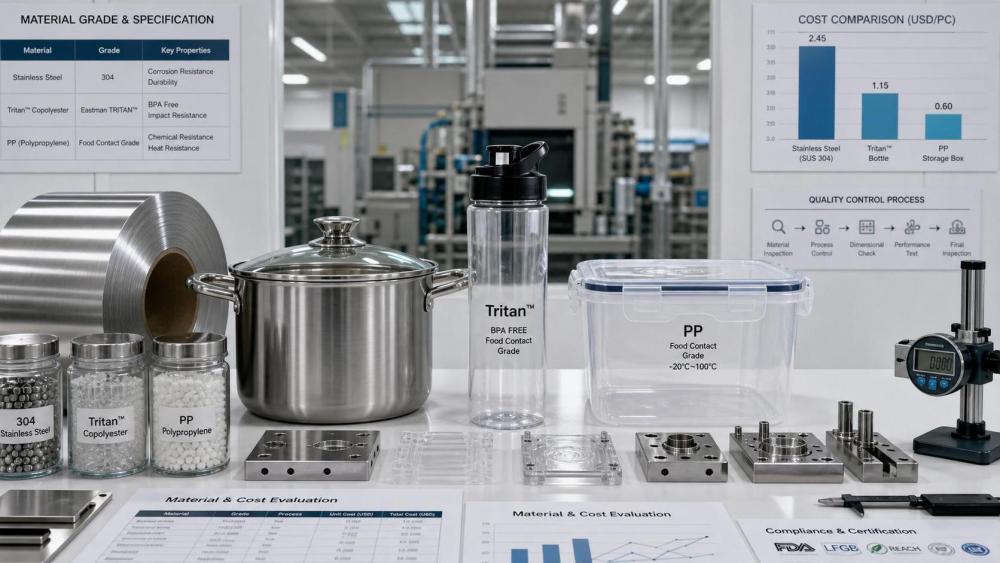
For sourcing teams, housewares material science cost is rarely just a number on a quote sheet.
It reflects raw material choice, process control, compliance work, tooling strategy, scrap rate, and how stable production stays over time.
That matters because two suppliers can offer similar-looking products with very different long-term economics.
A lower opening price may hide thinner steel, weaker polymers, unstable molding, or certification gaps that surface later.
A better reading of housewares material science cost helps buyers compare real value, not just invoice price.
In practical terms, it supports better supplier selection, fewer quality claims, and stronger margin protection.
Why Material Science Changes Unit Economics
The biggest driver in housewares material science cost is material behavior under real production and real use.
A stainless steel pan, a PP container, and a Tritan bottle can all look simple.
But each depends on different mechanical, thermal, and chemical performance standards.
That performance profile directly shapes resin cost, alloy cost, processing temperature, cycle time, yield, and testing needs.
For example, 304 and 316 stainless steel do not carry the same corrosion resistance or procurement cost.
Likewise, food-grade PP, Tritan, and silicone differ in transparency, impact strength, heat tolerance, and compliance pathways.
This is why housewares material science cost should be evaluated as a system, not as a raw material line item.
The Core Cost Drivers Behind the Quote
1. Material grade and specification
The first layer of housewares material science cost is specification accuracy.
Minor grade changes can shift cost significantly, especially in metal-heavy or high-performance plastic products.
- 304 vs 316 stainless steel affects corrosion resistance and raw material cost.
- Virgin resin vs mixed recycled content changes consistency and food-contact risk.
- High-clarity Tritan costs more than standard PP, but supports premium positioning.
- Platinum silicone often costs more than basic formulations, depending on use requirements.
In sourcing reviews, unclear specifications often create the widest quote spread.
2. Process complexity and conversion efficiency
The next major factor is how efficiently the material can be converted into a sellable product.
Tri-ply cookware is a good example.
Its unit price depends not only on steel and aluminum inputs, but also bonding quality, forming difficulty, and polishing loss.
For injection-molded housewares, cycle time, mold cooling, shrinkage control, and warpage rates are equally important.
When process stability is weak, housewares material science cost rises through scrap, rework, delays, and inconsistent dimensions.
3. Compliance and testing requirements
Food-contact and consumer safety standards are not side costs.
They are built into housewares material science cost from the start.
LFGB, FDA, REACH, and related migration tests require material traceability, sample preparation, lab work, and documentation control.
If a product uses coatings, colorants, seals, adhesives, or mixed materials, testing scope may expand further.
That is often where low quotes become less credible.
How Tooling and Volume Reshape Cost
Tooling economics strongly influence housewares material science cost, especially for private-label sourcing.
This is more visible in plastic storage, drinkware lids, smart pet parts, and bathroom hardware components.
A cheaper mold can reduce upfront spend, but it may also shorten tool life and increase dimensional drift.
That drift affects leak resistance, fit accuracy, assembly speed, and return rates.
Volume also changes the picture.
At low volumes, tooling amortization can dominate the unit cost.
At larger volumes, yield, cavity balance, automation, and maintenance planning matter more.
This also means quote comparison should separate one-time cost from repeat production cost.
Where Low Unit Price Usually Hides Risk
In real buying decisions, the lowest quote often compresses risk into places that are hard to see early.
That is why housewares material science cost should be tied to evidence, not assumptions.
Common hidden-risk areas include:
- Reduced wall thickness in bottles, containers, or hardware bodies.
- Substituted steel grades without updated mill certificates.
- Mixed resin input causing color shift, brittleness, or odor issues.
- Lower vacuum retention performance in insulated drinkware.
- Inconsistent seals, gaskets, or threads that weaken leak performance.
- Limited testing scope that misses destination-market requirements.
From a margin perspective, these issues usually cost more after launch than before order placement.
Returns, complaints, and replacement logistics can quickly erase a small purchase price advantage.
A Practical Framework for Comparing Suppliers
A useful way to evaluate housewares material science cost is to compare suppliers across five decision points.
- Confirm exact material grade, additive package, and thickness range.
- Review process capability for forming, molding, welding, polishing, or insulation.
- Check compliance history for the target market and product category.
- Separate tooling, sampling, testing, and mass production costs.
- Measure defect risk, not only quoted price.
This approach makes quote analysis more disciplined.
It also creates better negotiation leverage because discussions move from price pressure to technical clarity.
In many categories, the best sourcing outcome is not the cheapest unit.
It is the most stable cost-quality ratio across the full order cycle.
How to Use Housewares Material Science Cost in Negotiation
Better negotiations start with better cost structure visibility.
When housewares material science cost is clearly mapped, buyers can ask sharper questions.
- What cost reduction comes from process optimization instead of spec downgrades?
- Can tooling changes improve yield without changing product performance?
- Can volume planning reduce waste or setup frequency?
- Which compliance documents are included in the quoted scope?
- What tolerance limits are guaranteed in mass production?
These questions keep the conversation anchored in controllable drivers.
That usually leads to stronger agreements on specification lock, quality checkpoints, and change notification.
Final Takeaway for Better Sourcing Decisions
Housewares material science cost is the combined result of material grade, engineering reality, compliance burden, and manufacturing discipline.
Seen that way, unit price becomes easier to interpret.
A quote is no longer just cheap or expensive.
It becomes a signal about durability, process maturity, compliance readiness, and supply risk.
In actual procurement work, that perspective leads to better supplier comparisons and fewer surprises after launch.
The most effective next step is simple: audit every quote against the material, process, tooling, and compliance assumptions behind it.
That is where smarter cost control usually begins.
Recommended News