
Industry News
Curation by industry experts
Hot Articles
Popular Tags
NSF Faucets vs Standard Faucets: Key Compliance Differences
Why do NSF faucets matter more than many standard faucets?
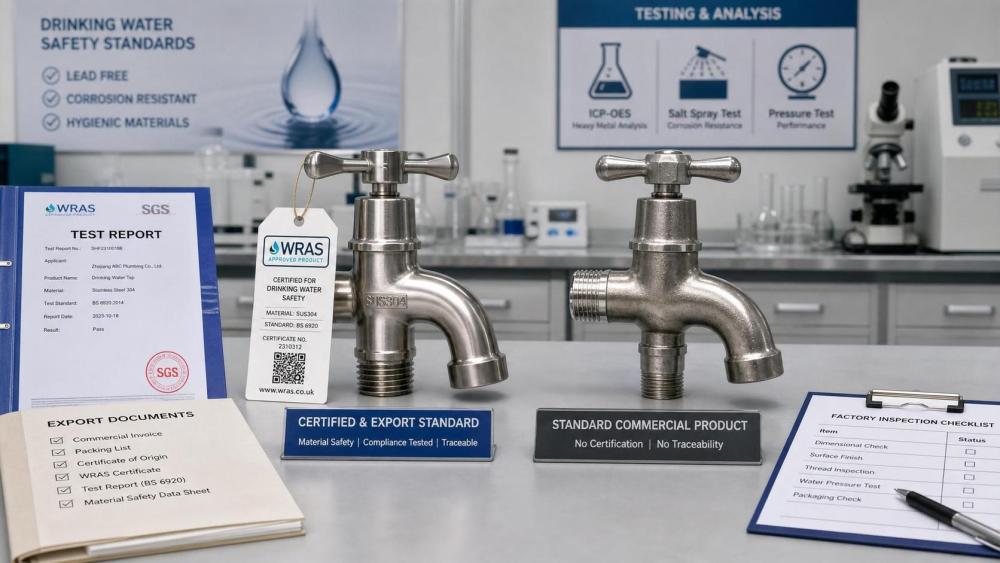
When a faucet is used for drinking water, compliance is not a cosmetic issue. It affects material safety, audit readiness, and product acceptance across regulated channels.
That is why NSF faucets receive closer scrutiny than standard faucets. The difference usually starts with verified testing, then extends into traceability, labeling, and production control.
In practical terms, a standard faucet may still perform well mechanically. But without recognized certification, it may not satisfy potable water requirements in foodservice, hospitality, healthcare, or export review.
For CHHS readers following sanitary hardware, food-contact compliance, and light industrial supply chains, this distinction matters because faucet approval often influences broader supplier qualification.
A common misunderstanding is that NSF faucets are simply premium faucets. They are not defined by appearance or price, but by whether the product and manufacturing controls align with specific compliance expectations.
What exactly makes a faucet “NSF” instead of standard?
The short answer is third-party certification against relevant standards. In North America, faucet review often involves NSF/ANSI 61 for drinking water system components and NSF/ANSI 372 for lead content.
Those standards focus on more than surface claims. They assess whether materials can leach harmful substances into water and whether the product remains within allowed limits during controlled testing.
Standard faucets may follow internal quality benchmarks or local factory checks. That can help consistency, but it does not replace independent compliance evidence.
Need to be careful here: “lead-free” and “NSF certified” are related, but not identical. A supplier may claim low lead content, yet still lack full certification scope for the assembled faucet.
More rigorous programs also review component-level control. Bodies, cartridges, hoses, seals, coatings, and wetted pathways all matter because drinking water touches the entire internal system.
A quick comparison helps
This is usually where NSF faucets separate themselves. The value is not only technical compliance, but also easier validation when specifications move across teams, countries, and channels.
Where do the biggest compliance differences show up in real inspections?
The biggest gap appears during document review. Inspectors and brand compliance teams often ask for current certificates, standard references, model coverage, and evidence that the listed product matches the shipped product.
NSF faucets usually perform better in that setting because the compliance story is clearer. Standard faucets may require extra declarations, test reports, or engineering explanations to close the same questions.
Another issue is change control. If a supplier switches brass composition, hose material, plating chemistry, or cartridge source, the compliance status can shift even when the faucet looks identical.
That is why experienced teams do not stop at seeing a logo. They confirm the exact model number, certification body, revision status, and whether the listed scope covers every wetted component.
In actual sourcing workflows, the hidden risk is mismatch. A sample may be certified, while the mass production version uses different internals to reduce cost or solve supply issues.
Useful checks before approval
- Verify the certificate is active and linked to the exact faucet model.
- Confirm the relevant NSF standard, not only a general compliance statement.
- Check whether flexible connectors and accessories are included in scope.
- Review change-control procedures for alloy, seals, coatings, and cartridge suppliers.
- Match packaging marks, technical file data, and shipment labels.
Are NSF faucets required in every project, or only in specific applications?
Not every project requires NSF faucets, but many potable water applications strongly favor them. The answer depends on use environment, regional code expectations, customer specifications, and liability tolerance.
For decorative washroom fittings with limited drinking water relevance, some markets accept other pathways. For kitchen faucets, drinking stations, institutional projects, and hospitality builds, scrutiny is often much higher.
This becomes more important when products cross borders. Export programs may face retailer compliance reviews, local plumbing rules, or bid documents that explicitly require listed NSF faucets.
CHHS often tracks this broader pattern across housewares and hardware categories. The same logic appears in food-contact containers, drinkware, and sanitary fittings: material claims matter less than verifiable compliance pathways.
A practical way to judge necessity is to ask one question first. Will this faucet be evaluated as part of a drinking water safety system, or as a basic plumbing fixture with lower certification pressure?
How should you compare NSF faucets and standard faucets during supplier qualification?
Price alone gives a distorted picture. NSF faucets often cost more because certification, testing, record control, and surveillance add real overhead.
Still, the cheaper standard faucet can become the expensive choice later. Delayed approvals, failed audits, replacement orders, and blocked shipments can erase the initial savings quickly.
A balanced review usually includes technical, documentary, and operational factors. Looking at only one layer leaves blind spots.
This comparison is especially useful for multi-category businesses. Faucet compliance often interacts with wider housewares governance, where food-contact materials, labeling, and supplier consistency are already under review.
What mistakes cause the most trouble with NSF faucets?
The first mistake is treating certification as a one-time event. NSF faucets need ongoing control, especially when materials, tooling, plating, or component vendors change.
The second mistake is relying on partial paperwork. A test report from years ago is not the same as a current product certification with traceable model coverage.
Another frequent problem is assuming every faucet from the same supplier shares the same status. Certification is often model-specific, and appearance similarity can be misleading.
There is also a timing issue. Teams sometimes confirm compliance after tooling approval or production launch, when design changes are expensive and schedule pressure is already building.
A better approach is to lock three things early: the applicable standard, the certified model scope, and the change-notification duty in supplier agreements.
Signs that extra review is needed
- The certificate number is missing from technical documents.
- The listed faucet image does not match the production sample.
- A supplier uses broad phrases such as “NSF material” instead of product certification details.
- Subcomponents come from multiple sources without locked specifications.
- Packaging and online claims differ from formal compliance files.
What is the smartest next step when choosing between NSF faucets and standard faucets?
Start with the water exposure scenario, not the catalog description. If the faucet supports drinking water use, the case for NSF faucets becomes much stronger.
Then build a short approval matrix. Include standard reference, certificate status, wetted material list, supplier change control, and document consistency across packaging and shipment files.
This keeps decisions grounded in evidence rather than assumption. It also reduces friction later when bids, inspections, or export reviews ask for proof.
In the end, the difference between NSF faucets and standard faucets is not just technical language. It is a risk management decision tied to water safety, compliance efficiency, and long-term supplier reliability.
For teams working across sanitary hardware and adjacent housewares categories, the same discipline applies everywhere: verify claims, trace materials, and confirm that the approved product is the one actually shipped.
That is the most reliable way to compare NSF faucets with confidence and to avoid expensive surprises after production has already moved forward.
Recommended News