
Industry News
Curation by industry experts
Hot Articles
Popular Tags
Kitchen Utensils Guide: Materials, Food Safety, and Durability
Why do kitchen utensils deserve a stricter material review than many teams expect?
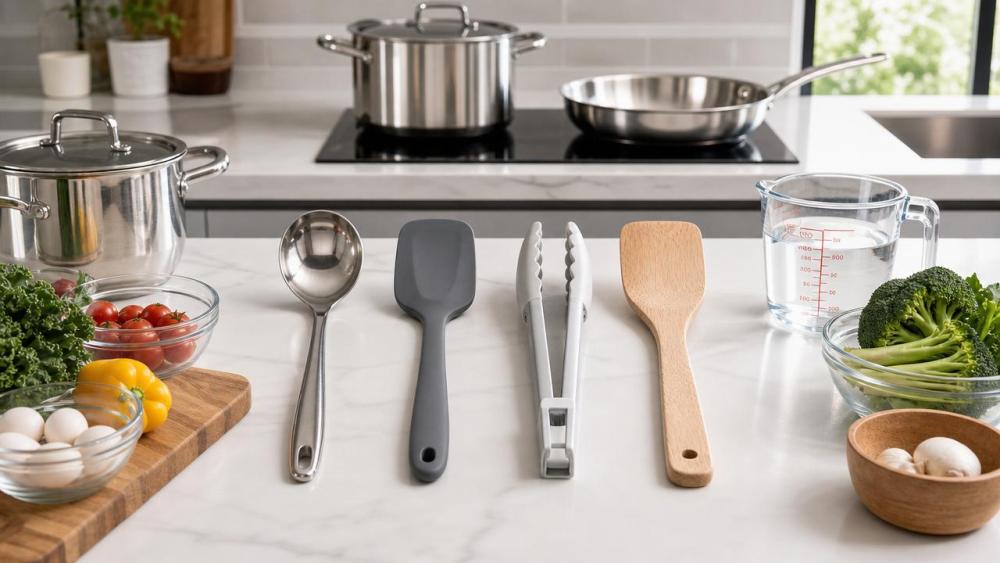
Kitchen utensils look simple, but they sit at the point where heat, food, moisture, detergents, and repeated handling meet every day.
That is why small defects can become larger safety issues.
A spoon, spatula, tong, ladle, whisk, or turner may contact acidic food, hot oil, dishwashing chemicals, and abrasion in a short cycle.
If the material choice is weak, the result is not only breakage.
More common concerns include odor retention, color migration, corrosion, burrs, coating failure, and hidden contamination risks.
In practical review work, kitchen utensils are often judged by appearance first.
That approach misses the bigger picture.
A glossy finish does not prove food-contact compliance.
A heavy handle does not prove structural durability.
A low unit cost does not mean lower total risk.
Within the wider housewares supply chain, this matters even more.
CHHS often frames product evaluation around material safety, processing quality, compliance readiness, and service-life consistency.
That perspective is useful because kitchen utensils are not isolated items.
They are part of a broader system of cookware, drinkware, plastics, silicone products, and stainless steel components.
So the right review question is not, “Does it work today?”
It is, “Will it stay safe and stable across real use, cleaning, and storage conditions?”
Which materials are most common in kitchen utensils, and where do the real safety differences appear?
Most kitchen utensils fall into four material groups: stainless steel, silicone, food-grade plastics, and wood or bamboo.
Each group solves a different problem, but each introduces a different control point.
Stainless steel: durable, but not all grades behave the same
Stainless steel kitchen utensils are trusted for strength, temperature resistance, and cleanability.
However, grade selection still matters.
304 stainless steel is widely used for food-contact tools.
It balances corrosion resistance and cost well.
Lower-grade steel may look similar, yet show earlier pitting or metallic taste issues under salty or acidic exposure.
Silicone: flexible and heat resistant, but formulation control is critical
Silicone kitchen utensils are common for nonstick cookware.
They reduce scratching and tolerate heat well.
The real issue is not silicone as a category.
It is the quality of the compound, fillers, curing process, and post-curing consistency.
Poorly processed silicone can show odor, surface oiling, tearing, or migration concerns.
Food-grade plastics: useful, but heat limits must be explicit
Nylon, PP, and other food-grade plastics are common in kitchen utensils because they are lightweight and cost-effective.
Still, thermal distortion is a frequent failure mode.
A plastic turner that passes room-temperature checks may warp near a pan edge.
That is why heat resistance claims should match actual application conditions.
Wood and bamboo: natural appeal with hygiene trade-offs
Wooden kitchen utensils are valued for low scratching and a natural look.
The challenge is moisture management.
Cracks, absorbency, glue quality in laminated parts, and coating integrity all affect food safety over time.
How can food-contact compliance for kitchen utensils be checked without relying on claims alone?
The safest approach is evidence-based review.
Marketing phrases such as “food safe” or “BPA free” are not enough.
A useful review starts with the bill of materials, then moves into declaration records, test scope, and production consistency.
For kitchen utensils, common checkpoints include FDA food-contact requirements, LFGB expectations, and migration-related testing where relevant.
Needless to say, the exact requirement depends on the target market and the utensil’s intended use.
A cold-food serving spoon does not face the same risk profile as a high-heat frying spatula.
More reliable evaluation usually asks four practical questions.
- Is the material grade clearly identified, rather than described in general terms?
- Do test reports match the actual color, formulation, and final structure?
- Are adhesives, coatings, inks, or decorative parts included in the compliance review?
- Does mass production follow the same process as the tested sample?
This last point is often overlooked.
Kitchen utensils may pass a lab test, then drift in production because pigment, resin source, curing time, or polishing media changes.
That is why CHHS often emphasizes compliance insight together with manufacturing control, not as separate topics.
A certificate has value, but process stability gives that certificate meaning.
What usually determines whether kitchen utensils last, stain, corrode, or fail early?
Durability is rarely controlled by one factor.
More often, it comes from the interaction between design, material, joining method, and finishing quality.
Take stainless steel kitchen utensils as an example.
If edges are not fully deburred, cleaning becomes harder and user injury risk increases.
If welding is rough, corrosion may start near the joint.
If handle geometry is weak, bending appears long before the metal itself fails.
For silicone and plastic kitchen utensils, the recurring weaknesses are different.
Look for heat deformation, cracking at stress points, color fading, surface tackiness, and separation between soft and rigid parts.
Dishwasher cycles can also expose poor bonding or unstable pigments.
The table below gives a faster screening view.
This kind of matrix helps separate cosmetic concerns from true durability risks.
It also supports more consistent reporting across suppliers and batches.
Where do kitchen utensils most often fail during supplier assessment or routine inspections?
Failures often appear in the details between material approval and finished-goods release.
One common problem is assuming that a compliant raw material guarantees a compliant product.
In reality, added colorants, soft-touch coatings, glue, rivets, and printed markings can change the risk profile.
Another issue is incomplete use-condition definition.
Some kitchen utensils are sold as multi-purpose tools, yet only tested for light or low-temperature contact.
That mismatch creates avoidable exposure later.
It is also worth checking finish quality with the same seriousness as chemical compliance.
Rough seams, trapped debris areas, sharp flash on molded parts, and unstable plating are all practical food-safety concerns.
In actual inspection routines, these points deserve special attention.
- Contact surfaces that are hard to clean after oily or sticky food use
- Mixed-material joints where water can remain after washing
- High-heat claims without matching deformation or aging checks
- Visual approval standards that ignore odor and tactile defects
These are not rare edge cases.
They are routine reasons why kitchen utensils pass incoming review yet generate complaints later.
How should kitchen utensils be compared when balancing safety, durability, and long-term consistency?
A useful comparison method starts with intended use, then moves to measurable controls.
For example, a serving utensil, a baking utensil, and a frying utensil should not share the same approval checklist.
The better approach is to build a decision frame around actual stress conditions.
That includes food type, temperature, cleaning method, expected service life, and user handling intensity.
When kitchen utensils are assessed this way, material choice becomes easier to justify.
A short working checklist can help.
- Define the highest real-use temperature, not the ideal one.
- Match food-contact tests to the actual market destination.
- Review joints, handles, coatings, and decorations as risk points.
- Request durability evidence after washing, abrasion, and repeated use.
- Track whether mass-production samples remain aligned with tested samples.
In broader category planning, this is where platforms like CHHS are useful as reference sources.
They connect compliance topics with processing realities across stainless steel, plastics, silicone, and other daily-use product systems.
That makes kitchen utensils easier to compare on evidence, not assumptions.
The practical next step is straightforward.
List the kitchen utensils under review by use condition, identify their highest-risk material points, and align testing, inspection, and supplier documents to those points.
When the review standard reflects real exposure, safety and durability decisions become much more reliable.
Recommended News