
Industry News
Curation by industry experts
Hot Articles
Popular Tags
Heat Retention Copper Liner: What Improves Thermal Performance?
What to check before you credit a heat retention copper liner for better insulation
For technical evaluators comparing insulated vessels and thermal systems, a heat retention copper liner is often discussed as a key factor in temperature stability. But what actually improves thermal performance—copper plating quality, vacuum integrity, stainless steel structure, or overall manufacturing control? This article examines the material, engineering, and production variables that determine whether a copper-lined design delivers measurable insulation advantages in real-world consumer housewares applications.
If you are reviewing insulated bottles, food jars, travel mugs, or related stainless steel vacuumware, the quickest mistake is to treat copper as the headline and everything else as background. In practice, a heat retention copper liner only works when the rest of the system is already under control. Poor vacuum, unstable weld quality, inconsistent gap spacing, or a badly designed stopper will erase any gain the copper layer might offer.
That is why experienced buyers and technical teams usually evaluate these products as a stack of checkpoints, not a single feature claim. Here is the checklist that matters.
Start with the real job of copper inside a vacuum vessel
A copper-coated liner in vacuum insulation is mainly there to reduce radiative heat transfer. It does not replace the vacuum layer, and it does not compensate for poor mechanical design. In a double-wall stainless steel bottle, heat moves by conduction, convection, and radiation. The vacuum suppresses convection and greatly reduces conduction across the air space. The copper layer helps reflect radiant heat and can improve overall thermal retention when it is properly applied.
So the first screening question is simple: is the supplier presenting copper plating as one element of a validated insulation system, or as a marketing shortcut? If it is the second, keep digging.
- Ask where the copper is applied: outer surface of the inner wall, inner surface of the outer wall, or another configuration.
- Confirm whether the vessel is truly vacuum insulated rather than simply double-wall.
- Check whether thermal claims are linked to test conditions, not just feature lists.
If those answers are vague, the copper discussion is already weak.
Vacuum integrity usually matters more than copper thickness
This is where many evaluations become more useful. A heat retention copper liner can support better thermal performance, but vacuum quality is normally the larger lever. Even a well-plated liner will underperform if residual gas in the vacuum gap is too high, if the seal degrades over time, or if manufacturing variation causes vessel-to-vessel inconsistency.
What you want from a supplier is not a generic statement like “high vacuum technology,” but process evidence. Ask how vacuum is achieved, how it is retained, and how it is checked in production. Some factories will discuss leak testing, vacuum sealing controls, aging checks, or destructive audit methods. The exact process can differ by line and equipment, but the point is whether they actually control it.
A practical buyer question: when thermal retention drifts in the field, is the root cause usually copper failure or vacuum failure? In many real sourcing situations, vacuum integrity is the more probable issue.
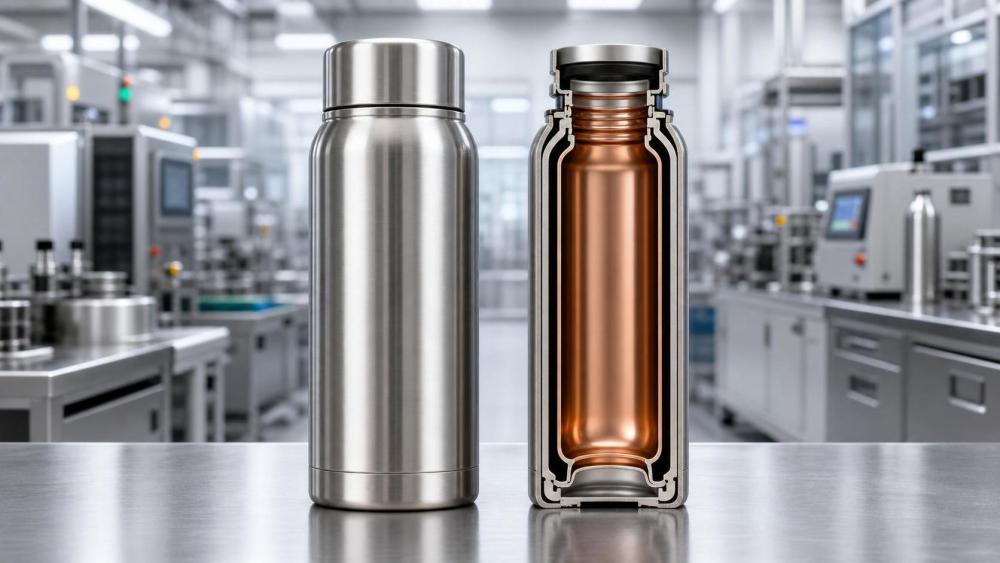
Look closely at copper plating quality, not just the fact that copper exists
Once vacuum performance is taken seriously, then the copper layer becomes worth examining in detail. A useful review is less about chasing a single “ideal” thickness and more about process consistency, adhesion, and coverage. Published consumer product listings often mention copper coating without telling you whether the deposition is uniform or stable through production.
The questions that tend to separate capable suppliers from surface-level ones are these:
- Is the copper layer applied with controlled repeatability across different bottle sizes and shapes?
- Does the supplier inspect coating continuity or only rely on line settings?
- Are there known edge-loss areas, especially around curves, neck transitions, or tight radii?
- Can they explain how copper plating interacts with subsequent welding, evacuation, and sealing steps?
If the factory cannot explain coverage challenges on different geometries, that is a warning sign. Narrow-neck insulated bottles, handled tumblers, and food jars do not all behave the same in plating and evacuation.
Do not ignore the stainless steel structure behind the liner
A copper-lined design still depends on the stainless steel body for dimensional stability, seam reliability, corrosion resistance, and food-contact suitability. In consumer housewares, common base materials may include 304 stainless steel and, in some premium drinkware discussions, 316 stainless steel for certain corrosion-focused applications. Material choice alone does not guarantee better thermal performance, but wall quality and forming consistency affect how reliably the vacuum chamber is built and sealed.
This matters more than it sounds. If the body has inconsistent thickness, distortion after welding, or unstable neck forming, the vacuum gap can vary. That changes thermal behavior. It can also create production headaches that get misdescribed as “normal tolerance.”
The lid, stopper, and drinking interface can quietly ruin the result
A lot of thermal comparisons are distorted by focusing on the vessel body while ignoring the closure system. For hot retention and cold retention, the lid design is often one of the biggest loss points. A bottle with a strong copper-lined vacuum body can still test poorly if the cap has thin insulation, poor gasket compression, unstable threads, or a large direct heat bridge through a metal drinking path.
This is especially relevant in travel mugs, flip-top drinkware, and straw-enabled products. They are convenient, but convenience usually introduces more heat leakage paths. Technical evaluators should separate “body insulation performance” from “assembled product thermal performance.” Suppliers do not always present that distinction clearly.
One practical move: ask for comparison data across the same body with different lids. If the supplier has never run that comparison, they may not fully understand where their product gains and losses actually come from.
Insist on test conditions before comparing claims
This is where many sourcing discussions go off track. “Keeps hot for 12 hours” or “longer heat retention” means very little unless the test method is defined. Initial fill temperature, ambient temperature, fill volume, preheating condition, lid status, and pass/fail threshold all affect the number.
You do not need to demand a single universal number if the product categories differ, but you do need comparable test logic. If a supplier references internal tests only, request the procedure. If they reference external standards, ask exactly which standard was used and whether the report is for the same structure you are evaluating. Do not assume a report from one SKU covers all derivatives.
For food-contact and housewares programs, thermal testing may sit alongside safety and compliance work, but it is not the same thing. LFGB, FDA-related food-contact compliance, or migration testing do not validate heat retention performance. Those are separate review tracks.
Watch for process drift in mass production
Some copper-lined samples perform well in development and then become less stable after scale-up. This is not unusual. The risk points are usually plating consistency, evacuation cycle control, weld stability, and closure component variation from secondary suppliers.
In other words, the sample may be good, but the production system may be weak.
- Ask for in-process quality controls, not only final inspection.
- Check whether thermal audits are done per batch, per shift, or only during qualification.
- Review whether rework is allowed on vacuum bodies and under what rules.
- Verify whether lid components come from a controlled source list.
If the supplier says all thermal testing is done only at the end, you still need to know how they catch process drift before finished goods accumulate.
Be careful with market-specific expectations and compliance language
For export programs, thermal performance is only one part of acceptance. Technical evaluators often have to align insulation review with food-contact material compliance, labeling, and customer-specific documentation. If copper is part of the hidden structure and not the food-contact surface, that does not remove the need to understand the full bill of materials and process chemistry. Surface treatments, sealants, welding residues, and gasket materials still matter.
Be precise in supplier communication. “Copper liner” can mean different things in different sales materials. Sometimes it refers to a plated layer used inside the vacuum system. Sometimes wording becomes loose in marketing copy. Your documents should identify where the copper sits, whether it is exposed to food or beverage contact, and what supporting compliance information is available. If the wording remains ambiguous, mark it 【待核实】 and do not clear the item based on brochure language.
A workable evaluation sequence for real sourcing decisions
When time is short, this is the order that usually saves the most trouble:
- Confirm the product is a genuine vacuum-insulated structure and map where the copper layer is used.
- Request thermal test conditions, not just the retention claim.
- Review vacuum retention controls and weld inspection methods.
- Check closure design and compare body-only versus assembled performance where possible.
- Verify stainless steel grade, traceability, and food-contact documentation relevant to your market.
- Ask how production consistency is monitored after pilot stage.
This sequence keeps the evaluation grounded. It also helps when two suppliers both advertise a heat retention copper liner but only one can explain the thermal system as a controlled manufacturing result.
What actually improves thermal performance
The short answer is: copper can help, but it helps inside a system that is already engineered well. The best-performing insulated vessels usually combine stable vacuum integrity, reliable copper coating application, controlled stainless steel forming, low-loss lid design, and production discipline that holds up after scale-up.
So when you assess a heat retention copper liner, do not ask only whether copper is present. Ask whether the supplier can show that the liner is part of a repeatable thermal design, tested under clear conditions, and manufactured with enough control to deliver the same result beyond the sample table. That is the difference between a feature claim and an insulation system you can actually trust.
Recommended News