
Industry News
Curation by industry experts
Hot Articles
Popular Tags
- consumer housewares
- kitchenware
- insulated drinkware
- sanitary hardware
- FDA food-contact standards
- 316 stainless steel
- vacuum flask technology
- copper-plated liners
- Corrosion resistance
- Coating durability
- thermal insulation
- cookware
- drinkware
- Cold retention
- Stainless steel processing
- kitchenware sourcing
Vacuum Flask Technology: How Heat Retention Really Works
Vacuum flask technology appears straightforward, yet real heat retention depends on a tightly engineered system. Material grade, vacuum quality, liner finish, neck geometry, and sealing accuracy all decide how long a drink stays hot or cold.
That is why this topic matters across insulated drinkware, kitchenware sourcing, and consumer housewares development. In practical terms, understanding how heat transfer is reduced helps separate a durable thermal flask from a product that only performs well on packaging claims.
What vacuum flask technology really does
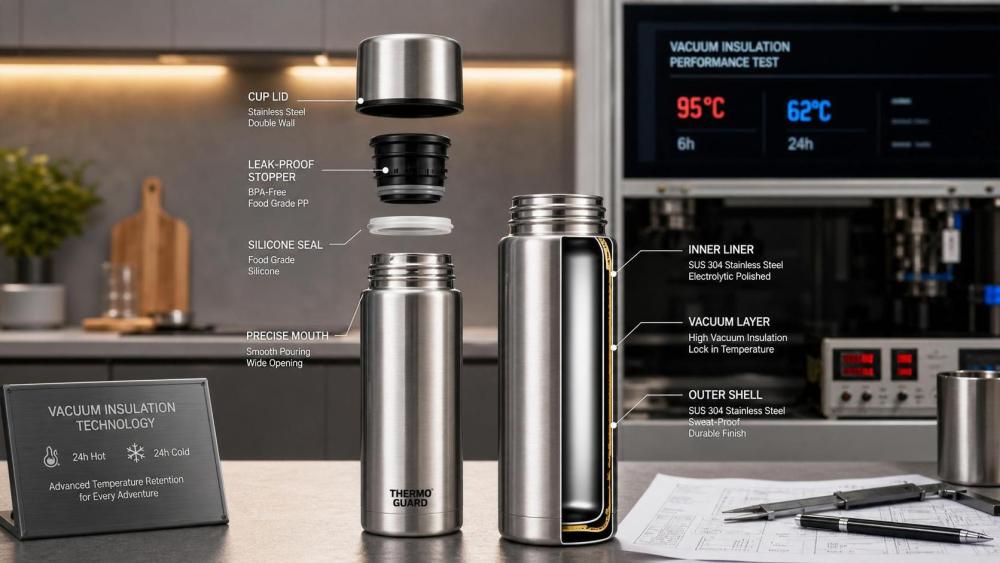
At its core, vacuum flask technology slows three forms of heat movement: conduction, convection, and radiation. A strong product does not stop heat completely. It reduces each pathway enough to extend temperature stability for hours.
The best-known feature is the vacuum layer between inner and outer walls. Because there is very little matter inside that gap, heat finds it harder to travel across the body of the flask.
That alone is not enough. Heat still escapes through the lid, neck, base, and any structural bridge connecting the two walls. This is where actual product engineering becomes more revealing than simple marketing language.
In CHHS coverage of insulated drinkware and stainless steel processing, this is a recurring theme. Thermal performance is usually the result of system balance, not one isolated feature.
How heat retention is won or lost
To understand vacuum flask technology, it helps to look at the main loss points. Some are obvious, while others are hidden inside production details.
The vacuum chamber
A deeper and more stable vacuum reduces conductive and convective transfer. If the vacuum weakens during manufacturing or over time, insulation performance drops sharply.
The reflective inner surface
Radiant heat still moves across empty space. For that reason, many products use polished stainless interiors or copper-plated liners to reflect thermal radiation back toward the liquid.
The lid and sealing assembly
The cap is often the weakest thermal area. A poorly insulated lid leaks heat much faster than the body. Silicone seals, thread precision, and internal lid structure matter more than they first appear.
The neck and contact points
Where inner and outer walls connect, heat can bridge through metal. Good vacuum flask technology minimizes this connection area while keeping the structure strong enough for repeated use.
Why materials matter beyond stainless steel labels
Not all stainless drinkware performs the same way. In vacuum flask technology, material selection affects corrosion resistance, weld quality, surface treatment, and long-term safety.
Most thermal flasks use 304 stainless steel for the liner and shell. In more demanding conditions, 316 stainless steel may be chosen for improved corrosion resistance, especially where mineral-rich liquids or harsher environments matter.
Material thickness also changes performance. Thicker steel can improve strength, but excess mass may alter weight, production cost, and heat response. Better performance does not always mean simply adding more metal.
Seal materials deserve equal attention. Food-contact silicone, plastic cap structures, and interface stability all influence leakage control, durability, and user perception. CHHS often links these decisions to both compliance and real product lifespan.
Why the market pays closer attention now
The insulated drinkware category has matured. Buyers now compare not only appearance, but also test results, food-contact safety, coating durability, and claimed holding times under realistic conditions.
This shift makes vacuum flask technology more visible across sourcing and product development. Premium positioning increasingly depends on measurable thermal performance rather than decorative branding alone.
There is also more scrutiny around compliance. FDA food-contact standards, LFGB expectations, stainless steel grade disclosure, and coating safety influence how products enter different markets.
For a platform such as CHHS, the topic sits naturally beside cookware metals, molded plastics, and sanitary hardware. In each case, hidden engineering details often determine user trust and commercial value.
Where vacuum flask technology creates business value
A well-designed flask does more than hold temperature. It supports product differentiation, reduces complaint risk, and improves consistency across retail, gifting, outdoor, office, and travel categories.
In actual business evaluation, heat retention affects several decisions at once:
- whether a product can support a premium price point
- whether returns may increase due to weak thermal claims
- whether private-label specifications are truly differentiated
- whether exported goods align with target market standards
- whether repeat orders will depend on stable production quality
This is why vacuum flask technology should be read as both a product topic and a supply chain topic. The value sits in design, production control, and claim verification together.
Typical product directions inside insulated drinkware
Not every flask is built for the same use pattern. Heat retention targets vary with volume, opening style, carry method, and consumption speed.
A compact coffee flask prioritizes short openings and sip convenience. A large outdoor bottle often prioritizes long hold times and stronger impact resistance. A children’s bottle may emphasize safety, cleaning access, and lighter weight.
Even shape matters. Wide-mouth designs are easier to clean and fill with ice, but they may lose heat faster after opening. Slim-neck structures usually protect temperature better, though they can reduce filling convenience.
Understanding these trade-offs makes vacuum flask technology easier to assess in context. A strong product is not universally best. It is appropriately engineered for its intended use.
How to evaluate performance claims more carefully
Heat retention numbers are meaningful only when test conditions are clear. Starting temperature, ambient temperature, fill volume, preheating, and measurement interval can change the result significantly.
When reviewing vacuum flask technology, these checkpoints are more useful than headline claims alone:
- whether hot and cold retention are tested separately
- whether the lid structure is insulated or only leak-resistant
- whether copper plating is used on the liner exterior
- whether welding, vacuum sealing, and polish quality are stable
- whether food-contact declarations match the target market
It is also worth comparing how a flask behaves after repeated opening cycles. In daily use, a bottle opened often can perform very differently from a sealed lab sample.
A practical way to read the category
Vacuum flask technology is best understood as a combination of physics, materials, and manufacturing discipline. The visible product may look simple, but small structural choices create large differences in actual holding time.
For deeper comparison, it helps to build a checklist around liner material, vacuum integrity, lid insulation, compliance readiness, and test method transparency. That approach usually gives a clearer picture than branding language alone.
CHHS places this topic within a broader housewares framework for the same reason. Thermal insulation, stainless steel processing, food-contact safety, and supply chain reliability all intersect in one everyday product.
The next useful step is to compare products by structure rather than appearance: review material declarations, ask how temperature data was measured, and check whether design details support the intended use scenario.
Recommended News