
Industry News
Curation by industry experts
Hot Articles
Popular Tags
Thermal Performance Test Method: Key Metrics and Common Mistakes
Thermal Performance Test Method: Key Metrics and Common Mistakes
Choosing the right thermal performance test method is critical for technical evaluators assessing cookware, insulated drinkware, sanitary hardware, and molded houseware products. A reliable test framework helps verify heat retention, temperature stability, energy efficiency, and material behavior under real-use conditions. This article explains the key metrics that matter most and highlights common mistakes that can distort results, weaken product validation, and create costly sourcing or compliance risks.
If you are evaluating thermal performance, the main mistake is treating all products as if they fail in the same way. They do not. A tri-ply pan, a vacuum bottle, a thermostatic shower valve, and a molded food container may all involve heat, but the thermal question is different in each case. One needs even heat distribution. Another needs heat retention over time. Another needs outlet temperature stability under flow variation. Another may simply need to survive hot filling or dishwasher cycles without distortion.
So before selecting a thermal performance test method, lock down the use condition you are actually trying to simulate. That sounds obvious, but it is where many evaluations already go off track.
Start with the thermal question, not the instrument
A lot of test plans are built around available lab equipment rather than the product claim being checked. That is backwards. Ask these questions first:
- Is the product supposed to retain heat, transfer heat, resist heat, or regulate temperature?
- Is the evaluation for design comparison, supplier approval, claim substantiation, or compliance support?
- What is the reference condition: ambient room use, boiling-fill use, stovetop cooking, repeated wash cycle, or hot-water flow operation?
- Which failure matters commercially: user discomfort, energy loss, deformation, leakage, coating damage, or unstable output temperature?
Once those answers are clear, the rest of the test method gets much easier to defend. For technical evaluators working with sourcing teams, this step also prevents a familiar problem: suppliers presenting “good” thermal numbers that are irrelevant to the actual buying requirement.
Key metrics worth checking before you trust the result
Not every report needs every metric. But if these are missing, you should at least ask why.
For insulated drinkware, one data point after six or twelve hours is rarely enough. You want the retention curve, initial fill temperature, fill volume, closure status, ambient condition, and whether the vessel was preconditioned. Otherwise you are comparing marketing numbers, not engineering results.
For cookware, average temperature can hide a bad pan. The practical question is usually uniformity across the cooking surface. An infrared image or mapped contact measurement often tells you more than a single center reading.
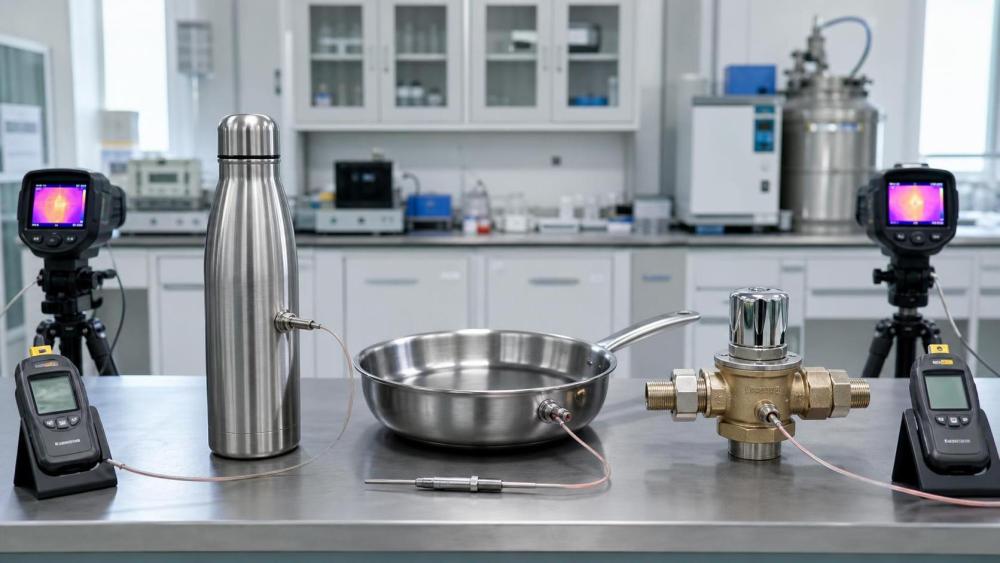
Checklist: what to lock down in the test setup
This is the part experienced reviewers usually inspect first, because weak setup control can make the rest of the report meaningless.
- Define the ambient condition clearly. Room temperature, humidity, airflow, and water temperature stability all influence thermal results. A bottle tested in still air and a bottle tested near active airflow are not equivalent.
- State the sample conditioning. Was the product preheated, precooled, washed, dried, or stabilized for a set period before testing? This especially matters for stainless steel drinkware and molded polymer parts.
- Confirm fill volume or load condition. “Filled with hot water” is not a method. You need volume, temperature, and tolerances. Headspace affects retention.
- Match the lid, seal, or assembled configuration to real use. Testing an insulated mug without the intended lid or gasket tells you almost nothing about field performance.
- Check sensor placement. If the probe touches a wall instead of measuring fluid temperature, the result can drift badly. This happens more often than people admit.
- Use enough replicates. One good sample proves very little in sourcing evaluation. Even a small replicate set is better than treating a single part as representative.
- Record timing discipline. Delay between fill, closure, and first measurement can materially change heat-loss calculations.
If your supplier test report does not specify these conditions, ask for the raw method sheet or internal SOP. Many disagreements around thermal performance are not really about product quality. They come from undocumented setup variation.
Common mistakes that distort thermal performance results
Some mistakes are technical. Some are procedural. Both can cost you the same amount of time.
Using the wrong acceptance logic. A pass/fail threshold copied from a similar product is not good enough. A wide-mouth food jar, a slim vacuum bottle, and a handled tumbler will not show identical heat-loss behavior even if the material stack looks similar.
Ignoring geometry. Shape influences convection, heat transfer area, and lid performance. In cookware, base thickness and layer construction can matter more than total weight. In bottles, mouth diameter and stopper design can dominate the result.
Confusing material grade with thermal outcome. Seeing 304 or 316 stainless steel on a spec sheet does not tell you the retention level of a vacuum bottle or the heating pattern of a pan. Construction quality, wall spacing, vacuum integrity, bonding, and base design are often the deciding factors.
Measuring too early or too late. Initial transient behavior can be noisy. On the other hand, waiting too long between checkpoints can hide where the major loss occurs. For retention studies, multiple timed readings are more useful than a dramatic single endpoint.
Skipping post-cycle inspection. Thermal performance is not just a number on a graph. After thermal cycling, inspect for seal creep, thread looseness, coating damage, base separation, handle instability, and dimensional shift. Especially with injection-molded accessories and assembled lids, the thermal number can look acceptable while the product is already moving toward field failure.
Not separating lab validity from claim language. A valid internal comparison test may still be too narrow to support a public-facing performance claim. Technical evaluators should flag that difference early.
Where standards matter, and where teams often overstate them
For products sold across markets, teams often want one neat answer: which standard covers thermal performance? In practice, the answer depends on category, market, and claim type. Some products have clearer test conventions than others. Some evaluations are driven more by buyer protocol or internal quality benchmarks than by one universal mandatory standard.
That is why you should distinguish between:
- recognized product standards or test standards, where applicable
- customer-specific protocols
- internal benchmark methods used for engineering comparison
- claim verification methods prepared for retail or e-commerce listing support
Do not let anyone blur those categories. A supplier saying “tested to standard” should be able to name the exact method, edition, sample condition, and result format. If not, treat the statement as incomplete.
For sanitary hardware such as thermostatic mixing valves, thermal stability claims may intersect with plumbing performance, safety, and regional certification frameworks. The exact applicable standards need market-specific verification【待核实】. The safe move is to ask for the method reference and the target sales region in the same conversation.
A practical way to review supplier reports
When a test report lands on your desk, read it like this:
- Check product identification. Model, size, material configuration, closure type, and production status should be clear.
- Check method traceability. Named method, equipment type, sensor type, environmental condition, and timing should be listed.
- Check whether the metric matches the claim. A heat retention claim supported only by a surface temperature snapshot is weak.
- Check variability. Look for replicate consistency, not just the best result.
- Check what was not said. Missing tolerances, missing diagrams, and missing sample photos usually mean more follow-up is needed.
In B2B sourcing, this review habit matters because thermal performance is often used as a proxy for manufacturing quality. Sometimes that is fair. Sometimes it hides the real issue, such as poor sealing consistency, unstable molding dimensions, or assembly variation between pilot and mass production.
What experienced evaluators usually do before approval
They do not rely on one thermal performance test method in isolation. They pair it with adjacent checks that explain the result: weld or joint integrity for vacuum products, layer construction review for cookware, seal material review for lids and closures, and dimensional checks after heat exposure for molded parts. That combination is what turns a thermal reading into a usable engineering decision.
If you need one rule to keep in mind, use this: a thermal test is only as credible as the use condition it reproduces and the documentation that surrounds it. When the method, setup, and acceptance logic are aligned, the result becomes useful for supplier comparison, claim review, and risk control. When they are vague, thermal data turns into decoration.
For technical evaluators working across cookware, insulated drinkware, sanitary hardware, and molded housewares, that difference is usually where expensive mistakes begin.
Recommended News