
Industry News
Curation by industry experts
Hot Articles
Popular Tags
How vacuum insulation design affects drinkware temperature retention
A bottle that feels cool on the outside while holding coffee for a long commute is not simply “double walled.” Its performance comes from a chain of thermal and manufacturing decisions that must work together: the vacuum gap, the geometry of the vessel, the reflective treatment of the inner wall, the neck design, the closure system, and the consistency of the production line.
For technical evaluators, this is where insulated drinkware design becomes more than a cosmetic or merchandising question. Two vessels may share a similar stainless-steel silhouette, capacity, and advertised use case, yet show noticeably different temperature retention in controlled tests. The reason is usually not one dramatic feature. It is the accumulation of small thermal bridges, uneven vacuum conditions, incomplete reflective coatings, poorly controlled lids, or test methods that do not reflect the intended use.
Understanding these interactions makes it easier to assess factory claims, compare samples fairly, write clearer product specifications, and identify whether a performance issue originates in engineering, assembly, or test setup.
Temperature retention begins with the three routes of heat transfer
Hot beverages lose heat, and cold beverages gain heat, through conduction, convection, and radiation. A well-engineered vacuum vessel is designed to interrupt all three pathways, although it cannot eliminate them completely.
Conduction occurs when heat moves through solid materials. In drinkware, the metal walls, base connection, neck area, and lid components can all conduct energy from the drink to the surrounding environment. Stainless steel is valued for food-contact durability, corrosion resistance, and appearance, but it still conducts heat. The critical design objective is therefore not to make steel non-conductive; it is to minimize the continuous paths through which heat can travel from the inner wall to the outer wall.
Convection is heat carried by moving air or liquid. The evacuated space between the inner and outer walls removes nearly all air from that cavity, greatly reducing convective transfer. This is why a genuine vacuum-insulated construction performs differently from ordinary double-wall drinkware, where trapped air can still circulate and transport heat.
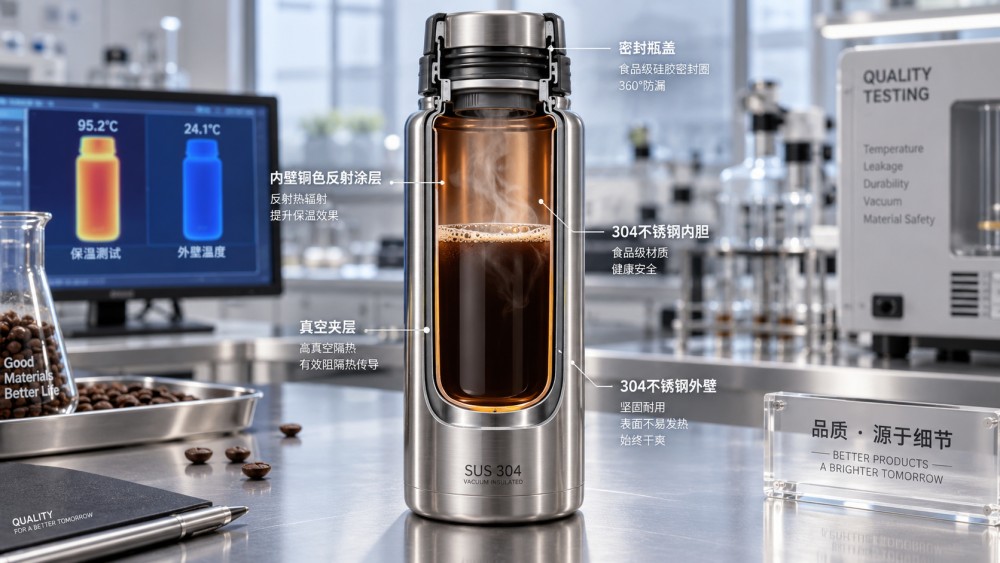
Thermal radiation remains important once conduction and convection across the wall gap have been reduced. Radiant energy can travel through a vacuum, so the interior-facing side of the evacuated cavity is often treated with a low-emissivity reflective layer. In industry discussions, this is commonly described as copper lining or copper plating, though the precise coating approach and location should be confirmed with the supplier rather than assumed from marketing language.
The practical lesson is simple: vacuum insulation is not a single feature. It is a thermal system. Weakness in one part of that system can reduce the value of the others.
The vacuum gap: quality matters as much as the presence of a vacuum
A vacuum chamber is central to insulated drinkware design, but technical review should go beyond asking whether the product is “vacuum insulated.” The relevant questions are how the vacuum is created, how reliably it is maintained, and whether the geometry supports stable evacuation and sealing.
During manufacturing, the inner and outer stainless-steel shells are assembled with a controlled gap between them. Air is evacuated through a designated port, which is then sealed. Residual gas inside the cavity can increase heat transfer. A vessel may initially look and feel correct but lose insulation effectiveness if the seal is compromised, if evacuation is inconsistent, or if contamination within the cavity affects the process.
Wall spacing also deserves attention. A larger gap is not automatically better. The spacing must support the intended shape, structural stability, forming process, and vacuum operation. Very narrow or irregular gaps can be difficult to control across complex contours. Large gaps may create other production or dimensional challenges. The most reliable designs balance thermal separation with repeatable forming, welding, and inspection.
Shape has consequences here. Straight bottles are generally easier to form and inspect than aggressively tapered tumblers, sculpted handles, or vessels with narrow waists. This does not mean shaped drinkware cannot achieve strong retention. It means that design complexity raises the importance of process validation. A visually appealing profile can introduce variation in wall gap, weld alignment, or internal surface treatment that would not be obvious in a final visual inspection.
Where heat escapes even when the body is well insulated
In many real-use situations, the bottle body is not the primary source of heat loss. The neck and lid assembly often determine whether the drinkware feels dependable in a backpack, car cup holder, office, or outdoor setting.
The mouth opening creates an unavoidable interruption in the insulated body. A wide-mouth food jar or tumbler offers convenient filling and cleaning, but its larger opening increases the area requiring careful closure design. Heat can leave through the cap structure, through gaps around a slider, and through air exchange when a drinking opening remains exposed.
Lids are usually built from several materials: polypropylene, Tritan, silicone, stainless steel, elastomeric seals, and sometimes internal metal inserts. Each choice affects thermal behavior, durability, transparency, dishwasher resistance, odor retention, and food-contact compliance. A clear lid may support product visibility, for example, but the geometry of its drinking port and gasket interface must still control leakage and air movement.
A technical evaluation should distinguish between a lid intended for transport and one intended mainly for convenient sipping. A straw lid, flip-top lid, slide lid, and fully threaded insulated cap cannot be expected to deliver identical retention. It is not a design failure when an open-drink tumbler cools more quickly than a sealed bottle; it becomes a sourcing problem when the tested result does not match the product’s stated configuration or intended claim.
Pay particular attention to the following areas:
- Thread engagement: Incomplete or uneven threads can create air paths and weaken the sealing feel.
- Gasket compression: A seal must compress consistently without being so tight that consumers struggle to remove the lid.
- Drinking-port design: Small gaps around sliders, straw ports, or flip mechanisms can become significant thermal and leak pathways.
- Metal-to-metal contact: Direct contact between inner and outer structural components near the neck can create a thermal bridge.
- Cap mass and material: A thin plastic cap may be practical and cost-effective, while a more insulated cap can improve performance in demanding hot or cold retention applications.
Reflective layers and the role of copper treatment
When buyers request copper-lined vacuum drinkware, they are usually trying to improve thermal performance by reducing radiant heat transfer. A reflective copper layer can lower emissivity on the relevant surface inside the evacuated space, helping the vessel retain heat or cold more effectively.
However, “copper plated” should not be treated as a universal guarantee of a particular outcome. The quality, continuity, placement, and process control of the reflective layer all matter. A coating that is uneven, damaged during forming, or inconsistently applied may not provide the expected benefit. Evaluators should ask for process information appropriate to the project, including where the treatment is applied, how it is protected during assembly, and how production consistency is monitored.
The coating also has to be considered in the context of the total design. A highly reflective liner cannot compensate for an unsealed lid or a major thermal bridge at the neck. Conversely, a carefully sealed lid may make a modestly engineered body appear strong in a short test. This is why component-level discussion and finished-product testing should be used together.
Material selection affects more than appearance
Most premium vacuum drinkware uses stainless steel for both the inner and outer shell. Grades such as 304 stainless steel are common in food-contact applications, while 316 stainless steel may be selected where enhanced corrosion resistance is important, including products exposed to saline environments, acidic beverages, or demanding cleaning conditions. The grade alone does not determine insulation performance, but it affects forming behavior, corrosion durability, weld quality, cost, and the product story presented to the market.
Inner-wall finish is also relevant. A well-controlled internal surface can support cleanability and reduce the risk of visible defects. For products intended for coffee, tea, flavored beverages, or sports nutrition, buyers may also consider taste transfer, stain visibility, and cleaning accessibility. These are not strictly thermal issues, yet they influence whether consumers continue using the product as intended.
External finishes require their own assessment. Powder coating, paint, electroplated effects, printed graphics, and bare stainless surfaces should be evaluated for abrasion resistance, adhesion, and compatibility with the intended washing method. An outer coating does not create the insulation, but damaged finishes can undermine perceived quality long before a retention test is repeated.
How to interpret temperature-retention test results
A retention claim is meaningful only when the test conditions are clear. Technical teams should be cautious when comparing reports that use different fill temperatures, ambient temperatures, fill volumes, lid states, test durations, or vessel orientations. A result from a nearly full bottle with a tightly closed cap in a stable room is not directly comparable with a partially filled tumbler tested with a sipping port exposed.
A robust test protocol normally defines the starting liquid temperature, ambient environment, nominal capacity and actual fill volume, closure configuration, measurement intervals, test duration, and acceptance criterion. It should also specify whether the vessel is preconditioned. Preheating a hot-drink vessel or precooling a cold-drink vessel can be relevant to actual consumer use, but it must be consistently applied if data are used for supplier comparison.
Cold retention testing needs extra care because condensation, ice content, and opening frequency can alter results. Hot testing similarly requires attention to safe handling and measurement technique. Temperature should be measured consistently, avoiding misleading readings influenced by the vessel’s opening or temporary heat loss during lid removal.
Rather than accepting a single report, request repeat testing across representative production samples. One excellent sample can demonstrate possibility; a group of samples gives a better indication of process capability. For a private-label program, this distinction can protect against a common frustration: approved development samples followed by inconsistent bulk production.
Manufacturing consistency is the hidden part of the specification
Vacuum drinkware is often judged at the end of the line, but quality is built much earlier. Deep drawing or other forming operations establish the shell geometry. Welding joins structural sections. Vacuuming and sealing establish the insulation chamber. Polishing, coating, lid assembly, and final leak testing complete the product. Variation at any stage can surface as poor temperature retention, an uneven base, cosmetic defects, leakage, or difficulty opening the lid.
For evaluators working with manufacturers, the most useful questions are often operational rather than promotional. How are vacuum leaks detected? Is there an in-process thermal screening method? How are neck dimensions controlled before lid fit is verified? How are gasket materials traced and inspected? What happens when a vessel fails a vacuum or leakage check? Is it reworked, segregated, or scrapped?
Sampling plans should cover more than visual appearance. Include lid torque or fit, leak resistance, temperature retention under the agreed protocol, coating integrity where applicable, capacity, base stability, and food-contact material documentation. If the product is sold across multiple regions, the compliance review should align with the applicable market requirements, such as relevant FDA food-contact expectations in the United States or LFGB-oriented documentation and testing practices commonly requested for European distribution. Requirements vary by product and market, so claims should be tied to the actual material system and test scope.
Common evaluation mistakes that distort sourcing decisions
One frequent mistake is comparing a sealed bottle against a tumbler with an open or semi-open sip lid. Another is reviewing a thermal report without confirming the actual lid used during testing. Teams also sometimes prioritize stainless-steel grade while overlooking the more immediate performance impact of vacuum integrity and closure design.
There is a similar risk in focusing on hours of retention without defining the endpoint. “Keeps hot” can mean very different things depending on whether the beverage remains comfortably warm, suitable for serving, or close to its original temperature. A well-written specification should replace broad language with a measurable condition agreed by both buyer and supplier.
Finally, do not treat insulation as separate from user experience. A cap that retains heat exceptionally well but is difficult to clean, a straw system that leaks in transit, or a bottle that is too heavy for its intended audience may fail commercially despite impressive laboratory performance. The strongest insulated drinkware design matches thermal engineering to the use case rather than pursuing one headline number in isolation.
A practical decision framework for technical teams
When reviewing a new bottle, mug, thermos, or tumbler, begin with the intended behavior: commuting with hot coffee, all-day cold hydration, outdoor use, child-friendly drinking, food transport, or premium gifting. That use case determines the right mouth size, lid type, capacity, material mix, retention target, and durability expectations.
Then examine the vessel as a system. Confirm the double-wall vacuum construction and its quality controls. Review the role of reflective treatment where required. Look closely at the neck, lid, gasket, and drinking mechanism. Agree on a test protocol before comparing samples. Finally, connect engineering performance to manufacturing repeatability and market compliance.
For the housewares supply chain, this approach creates a more useful conversation than asking whether a product is simply “vacuum insulated.” It reveals whether the design can deliver the thermal experience consumers expect, whether the factory can reproduce it at scale, and whether the final product is suitable for the channel, region, and brand promise it is meant to serve.
Recommended News