
Industry News
Curation by industry experts
Hot Articles
Popular Tags
How stainless vacuum flask design affects heat retention
Heat retention in a stainless vacuum flask is determined less by the grade name printed on the body than by the way heat paths are controlled across the entire assembly. A flask can use food-contact stainless steel and still perform poorly if its vacuum gap is unstable, its stopper conducts heat, its lid leaks air, or its neck geometry creates an oversized thermal bridge.
The central engineering task is simple in principle: slow the movement of heat from the beverage to the surrounding environment, or from a hot exterior environment into a cold beverage. In practice, a stainless vacuum flask must limit three different mechanisms at once: conduction through solid components, convection through residual gas or leaked air, and thermal radiation across the evacuated space. The best stainless vacuum flask design addresses all three rather than relying on a single feature such as “double-wall insulation.”
Vacuum construction is the primary insulation system
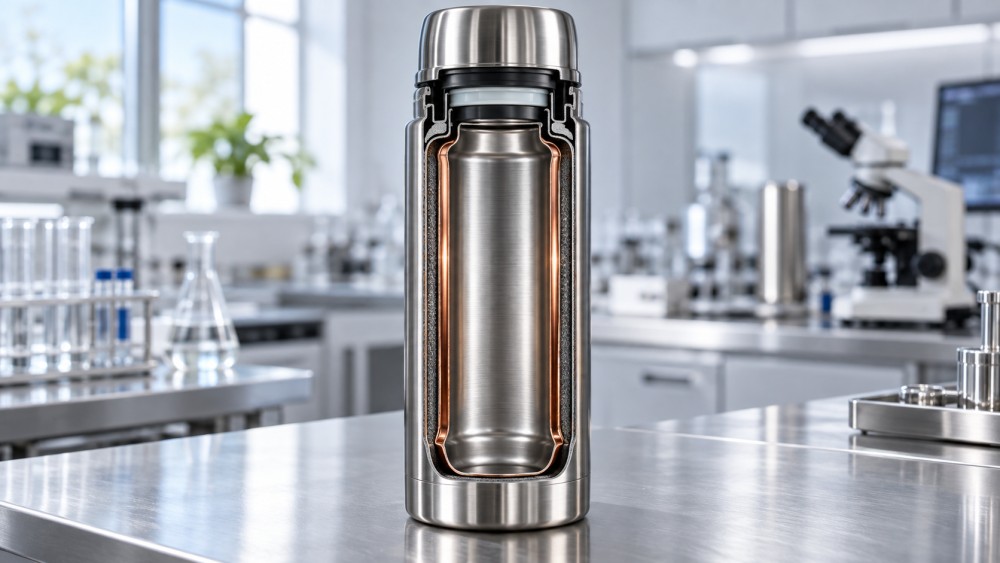
A genuine vacuum flask has an inner vessel that holds the beverage and an outer shell that provides protection and handling. The space between them is evacuated and permanently sealed. Removing air from that gap largely suppresses convective heat transfer: there is no substantial volume of moving air to carry heat from one wall to the other.
This distinction matters because a double-wall bottle is not necessarily a vacuum-insulated bottle. A non-vacuum double-wall structure can reduce direct contact with the exterior and improve surface comfort, but air remains between the walls. That air can circulate when temperature differences are large enough, allowing heat to transfer more quickly. The thermal performance difference becomes especially visible over several hours rather than during a short initial holding period.
Vacuum quality is not visible from the outside. It depends on manufacturing controls that include evacuation, sealing, welding integrity, and the cleanliness of the cavity before it is sealed. Moisture, processing residues, trapped gases, or a microscopic leak can degrade the vacuum. The bottle may initially feel acceptable but lose retention capacity over time as gas enters the inter-wall space.
For this reason, the outer wall temperature can offer a useful preliminary signal, though it is not a complete test. When a vessel is filled with hot liquid, an outer wall that quickly becomes noticeably warm may indicate a significant heat path. It can result from poor vacuum performance, but it can also be caused by a local thermal bridge near the neck, base, or welded joint. A cool body does not automatically prove the full system is efficient; the lid can remain the dominant loss point.
Heat does not only cross the flask body
The main body is often the most visually prominent part of a flask, yet the closure system commonly determines the practical result. The stopper, threaded collar, lid gasket, drinking spout, and carrying handle all sit near the opening, where the inner and outer structures must be connected mechanically. This area is inherently more difficult to insulate than a broad cylindrical wall.
Stainless steel is strong, corrosion-resistant, and suitable for durable food-contact vessels, but it conducts heat far more readily than a vacuum. Whenever the inner liner and outer shell are connected through metal, a conductive route is created. Flask engineering therefore aims to minimize the cross-sectional area and continuity of those connections while retaining enough strength for forming, welding, impact resistance, and pressure changes during filling.
The neck is particularly important. A wide metal neck can improve filling convenience, accommodate ice cubes, and simplify cleaning, but it increases the area through which heat can travel. A narrow neck reduces this route and also reduces the exposed liquid surface when the flask is opened. Neither configuration is universally superior. Wide-mouth designs are useful for food, ice, and easy cleaning, while narrow-neck vessels can have an advantage in long-duration temperature retention when the closure is equally well designed.
At the bottom, the inner and outer walls must also be joined or structurally supported. Excessive metal continuity at this point can create a cold or hot spot. Designs may use a minimized contact region, a carefully shaped base connection, or external protective features that reduce direct handling damage without unnecessarily enlarging the conductive path.
The lid is an insulation component, not merely an accessory
A cap that seals liquid effectively may still be a weak thermal barrier. Temperature retention depends on whether the lid limits air exchange, vapor escape, conductive transfer through rigid components, and heat loss from the opening.
For hot beverages, a poor seal allows warm, humid air to leave the flask and be replaced by cooler ambient air. This creates a direct energy loss mechanism that is much faster than heat transfer through a sound vacuum wall. It may also cause condensation around the mouth or inside an outer cup. For cold beverages, the same imperfect seal permits warm, moist outside air to enter, increasing heat gain and potentially creating condensation.
Gaskets made from suitable elastomeric materials provide the compression needed to maintain a seal. Their design is more consequential than their appearance suggests. The gasket must fit the mating surfaces, resist repeated compression, tolerate expected beverage temperatures, and remain stable after cleaning cycles. A gasket that is too hard may not conform properly; one that is too soft can deform, shift, or become difficult to clean. Thread design matters as well: a closure that cross-threads easily or depends on excessive tightening is more likely to produce inconsistent sealing in normal use.
Multi-part lids need additional scrutiny. A flip-top, push-button, straw lid, or one-handed drinking mechanism creates more joints and moving interfaces than a simple screw cap. Such designs can be highly functional, but each added opening is a possible leakage and heat-loss route. A sip lid optimized for immediate drinking convenience should not be assumed to match the retention of a fully sealed stopper intended for transport and extended storage.
Some flasks use a cup-style overcap. This can add another layer of still air around the stopper and protect the closure from external temperature exposure. Its contribution should not be overstated, but it can improve the overall system when paired with a well-insulated inner cap. An outer cup alone cannot compensate for a conductive stopper or a leaking primary seal.
Wall material influences durability and process control more than vacuum physics
Stainless steel grades are often used as shorthand for quality, yet they do not independently determine thermal retention. The vacuum gap, thermal bridges, closure design, and radiation control have greater direct influence on insulation performance.
Common austenitic stainless steels are used because they combine corrosion resistance, formability, weldability, and acceptable performance with many beverages. Grade selection remains relevant to the service environment. A flask exposed to acidic drinks, salty residues, aggressive cleaning chemicals, or coastal storage conditions may require stronger corrosion resistance than one used only for water. Corrosion at welds, seams, or damaged surfaces can compromise hygiene, appearance, and eventually structural integrity.
The material also affects the consistency of deep drawing, spinning, welding, and polishing. An inner liner with uneven thickness, distorted geometry, or poorly controlled weld zones can create difficulties in maintaining a uniform inter-wall gap. The effect is indirect but important: stable forming and joining processes support a stable insulation structure.
Claims about “316 stainless steel” should therefore be separated into two questions. The first is whether the stated material grade is appropriate and verifiable for the intended food-contact and corrosion environment. The second is whether the flask construction actually provides the claimed temperature retention. A higher alloy grade does not rescue an inadequate vacuum system or a poorly engineered lid.
Radiation control becomes important once air is removed
In a vacuum, conduction and convection are strongly reduced, but radiant heat can still pass between the warmer and cooler walls. This is why some vacuum flasks use a reflective treatment on the external surface of the inner vessel, often described as a copper coating or copper-plated liner. The purpose is to lower emissivity and reflect thermal radiation back toward its source.
The coating is usually located inside the sealed vacuum cavity, not on the beverage-contact surface. Its performance depends on coverage, adhesion, continuity, and protection during manufacturing. If the reflective layer is damaged, contaminated, or poorly applied, its radiation-control effect can be reduced. It should also be understood as a supporting feature rather than a substitute for proper evacuation. A reflective layer cannot stop convective heat loss if the vacuum cavity contains too much residual gas.
External finishes have a different role. Powder coating, paint, bare polished steel, and textured finishes can affect grip, scratch resistance, and perceived surface temperature. Their influence on total heat retention is generally secondary to the internal vacuum system. However, a dark exterior exposed to strong sunlight can absorb more radiant energy than a highly reflective exterior, which may matter in outdoor use. That is an environmental exposure issue rather than a measure of the flask’s core insulation quality.
Geometry changes both heat flow and real-world use
Tall, narrow bodies generally have less exterior surface area than short, wide bodies of the same volume. Less surface area can reduce heat exchange with the environment, although the advantage is moderated by the lid, neck, and base. A compact wide flask may be more convenient for food or a vehicle cup holder but may expose more area to ambient conditions.
The relationship between volume and surface area also explains why larger flasks can appear to retain temperature better over a given period. A larger volume stores more thermal energy relative to its exposed area. This does not necessarily mean the construction is better. Comparing a 1.0 L flask with a 350 mL bottle using only the final temperature after the same number of hours can lead to misleading conclusions.
Headspace is another overlooked variable. A partially filled hot flask contains more air volume above the liquid. Each time the lid is opened, this air exchanges with ambient air. Greater headspace can therefore reduce retention in practical use, especially for small remaining beverage volumes. Product claims should specify fill level because a test conducted near nominal capacity is not equivalent to use at half capacity.
Internal geometry affects cleaning and beverage handling. Complex shoulders, narrow transitions, and deeply recessed threads can hold residues. A design that retains heat well but cannot be cleaned effectively is not automatically a stronger product for tea, coffee, milk-based drinks, soups, or flavored beverages. Thermal design and hygienic design must coexist.
Temperature claims only have meaning when the test conditions are stated
Statements such as “keeps hot for 12 hours” or “keeps cold for 24 hours” are incomplete unless they identify the test method. A meaningful retention claim needs, at minimum, the starting liquid temperature, ambient temperature, fill volume, test duration, closure condition, and final measured temperature. The measured location also matters: liquid temperature should be distinguished from exterior surface temperature.
Hot and cold tests should not be treated as symmetrical marketing numbers. Heat transfer depends on the temperature difference between the contents and surroundings, the exposure conditions, and whether the flask is opened. A cold test starting with ice water may remain visually “cold” because ice absorbs heat while melting, making its result difficult to compare with a test using chilled water without ice. Similarly, a hot test based on water near boiling point is not equivalent to a beverage filled at a lower serving temperature.
For comparison work, the most useful approach is to normalize the conditions. Test equivalent fill volumes in the same ambient environment, use the same opening protocol, and record the temperature drop or rise at defined intervals. Where a supplier provides performance data, the request should include the actual protocol rather than only the headline hours.
There is no single global temperature-retention claim format that makes all consumer flask labels directly comparable. Food-contact compliance and thermal performance are also separate matters. Requirements applicable to materials in contact with food address chemical safety and migration risks; they do not certify that a flask has a specific insulation duration. Likewise, a declaration of stainless steel grade is not proof of vacuum integrity.
Failure patterns reveal where a design is vulnerable
A bottle that loses thermal performance suddenly after impact may have suffered damage to the vacuum seal or an internal joint. The exterior may begin to feel unusually hot with hot contents or unusually cold with iced contents. This is different from gradual loss caused by a worn gasket, damaged lid, or insufficient tightening.
Localized warmth near the neck does not always mean the product has failed. Some heat transfer through the closure region is expected because the system requires structural connections. The relevant question is whether that path is proportionate to the flask’s intended retention claim and whether the body remains effectively isolated.
Condensation is also diagnostic. Condensation on the outer body when holding a cold beverage can indicate significant heat transfer through the wall or a damaged vacuum. Condensation near a drinking port can instead result from normal exposure of cold internal components to humid air. The location and pattern matter more than the mere presence of moisture.
Dents should be assessed carefully. A shallow dent in the outer shell may be cosmetic, but a deep impact can reduce the spacing between walls, create a point of contact, or damage the sealed structure. If the inner and outer walls touch, heat can bypass the vacuum at that location through direct conduction.
What separates a credible flask design from a superficial specification
A stainless vacuum flask should be evaluated as a thermal system: evacuated double walls, minimized metal bridges, a stable reflective barrier where used, a closure that limits both leakage and conduction, and geometry suited to the intended use. Material grade, finish, and capacity remain relevant, but they are not substitutes for this system-level view.
The most reliable technical comparison does not begin with a generic “hot” or “cold” promise. It begins with the construction details and the test conditions behind the claim. Once those are visible, differences between a narrow-neck travel flask, a wide-mouth food jar, a straw tumbler, and a conventional screw-cap bottle become easier to interpret. Each can be well designed for its purpose, but their heat-retention performance should not be expected to be identical.
Recommended News