
Industry News
Curation by industry experts
Hot Articles
Popular Tags
Does copper lining improve vacuum insulation in drinkware?
Does copper lining improve vacuum insulation in drinkware, or is it simply a premium-looking feature added to a product specification? The short answer is: it can improve performance, but only when it is applied in the right place and supported by a well-made vacuum structure. Copper is not a substitute for a proper vacuum, accurate welding, or a reliable lid. It is a thermal-control layer that addresses one part of heat transfer that remains after air has been removed from the bottle wall.
For product developers, retail buyers, and sourcing teams comparing a vacuum insulation copper lined bottle with a standard stainless steel model, the important question is not whether copper sounds more advanced. The question is whether the supplier can explain the coating location, manufacturing method, adhesion quality, thermal test conditions, and food-contact design. Those details reveal whether copper plating is contributing to a genuinely stronger product or merely decorating a sales claim.
What a vacuum bottle must prevent
A double-wall insulated bottle loses or gains heat through three main pathways: conduction, convection, and radiation. The vacuum between the inner and outer stainless steel walls is designed to minimize the first two. With very little gas remaining inside the gap, there are far fewer molecules available to carry heat from one wall to the other.
That vacuum is the foundation of thermal performance. If it is weak, contaminated, or lost through a leak, a copper layer will not rescue the bottle. Heat can then move much more easily through the remaining gas, and the container’s temperature retention drops quickly.
Radiant heat transfer is different. Even in a strong vacuum, surfaces can still exchange thermal energy through infrared radiation. A reflective metal coating, particularly copper, can lower the amount of radiative heat crossing the vacuum space. This is where copper-lined vacuum insulation has a practical engineering role.
Copper is usually a reflective barrier, not a beverage-contact liner
The phrase “copper lining” can be misleading. In most insulated drinkware, copper is not intended to touch water, coffee, tea, or other beverages. Instead, a thin copper coating is commonly applied to the outer surface of the inner stainless steel vessel—the surface facing the vacuum gap. It is therefore hidden between the two walls after assembly.
Placed there, the copper coating reflects part of the thermal radiation that would otherwise travel between the inner and outer walls. This can help a hot drink remain hot and a cold drink remain cold, especially when the bottle already has a stable vacuum and a carefully designed neck structure.
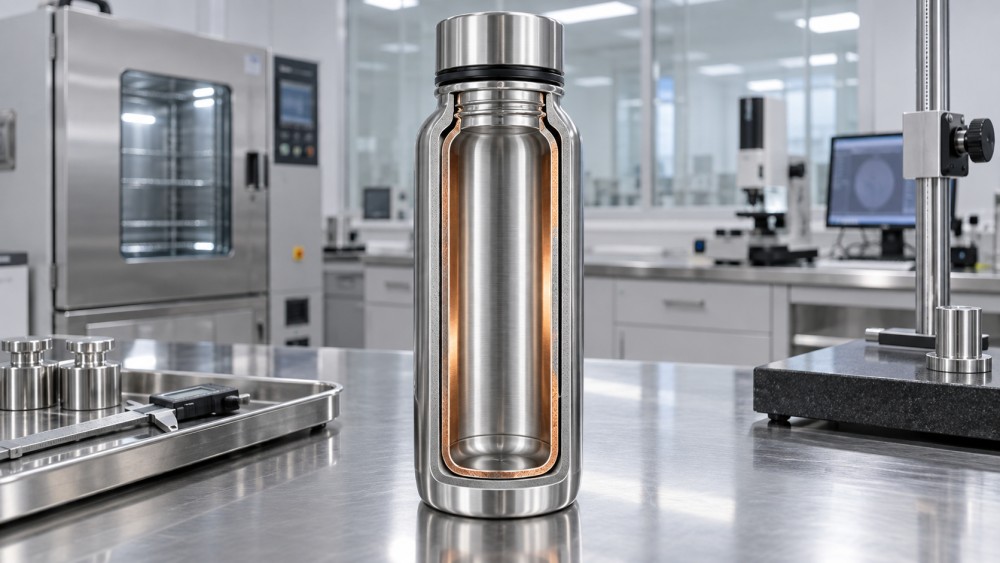
The distinction matters for both safety and sourcing. A bottle marketed as “copper lined” should not automatically be assumed to have copper on the drinking surface. If a supplier uses the term without a sectional drawing or clear technical explanation, buyers should ask for clarification. The construction may involve a vacuum-side copper plating, a decorative exterior finish, or—in less common cases—a separate copper component with a different function.
How much does copper improve vacuum insulation?
Copper can make a measurable difference, but it should be described as an optimization rather than a miracle material. The actual benefit depends on the complete thermal system: bottle shape, wall spacing, vacuum quality, stainless steel grade, neck geometry, stopper design, lid insulation, fill level, ambient temperature, and test duration.
A wide-mouth food jar, for example, has a larger opening and often a more thermally demanding lid than a narrow-neck bottle. In that design, heat loss through the closure and mouth area may matter as much as, or more than, radiation through the body wall. A copper-plated liner can still help, but the customer may see less benefit if the cap is poorly insulated.
Likewise, a bottle designed for iced drinks may be limited by condensation control, lid leakage, or heat entering through the exposed stainless steel rim. Thermal retention claims must therefore be evaluated as finished-product results, not as a material claim based on copper alone.
In practical category planning, copper plating is most meaningful when it is paired with:
- a consistently maintained high-vacuum gap;
- low-conductivity structural connections between the two walls;
- an insulated cap or stopper with controlled air channels;
- minimal exposed metal bridges around the neck and base;
- repeatable welding and evacuation processes;
- clear temperature-retention testing under defined conditions.
Without these elements, a copper-lined claim can create an expectation that the product cannot reliably meet.
Why copper is used instead of relying on stainless steel alone
Stainless steel is durable, corrosion-resistant, and suitable for food-contact applications when the selected grade and production controls are appropriate. It is also the familiar material consumers expect in reusable drinkware. However, bare stainless surfaces do not reflect thermal radiation in the same way as a purpose-applied, low-emissivity copper layer.
Copper has high thermal conductivity, which sometimes causes confusion. In a solid metal connection between inner and outer walls, high conductivity would be undesirable because it could create a heat bridge. But in the vacuum gap, where the coating is thin and does not form a direct bridge across the two walls, its reflective behavior is the more relevant property. The copper layer is intended to reduce radiative exchange, not to conduct heat from one wall to the other.
This also explains why coating placement is critical. A technically sound process keeps the copper layer continuous enough to perform its reflective role while avoiding defects that could compromise assembly, vacuum sealing, or corrosion resistance over time.
The manufacturing details that buyers should investigate
Two bottles can both be described as copper plated yet perform very differently. The difference often begins long before final assembly, at surface preparation and process control.
Surface cleanliness and coating adhesion
The inner stainless steel vessel must be clean and properly prepared before copper deposition. Oils, polishing residues, fingerprints, oxide layers, or inconsistent activation can affect adhesion. If the coating is poorly bonded, it may flake, discolor, or lose continuity during handling and welding operations. Because the layer is hidden, visual inspection alone may not reveal every issue.
Coating coverage and process consistency
Uniformity matters more than a dramatic description of plating thickness. Incomplete coverage, patchy deposition, or uncontrolled variation between production lots can reduce the coating’s value. Buyers do not necessarily need to prescribe a particular proprietary process, but they should ask how the factory monitors coverage and validates lot-to-lot repeatability.
Vacuum sealing after plating
A copper-plated inner liner still needs to be joined to the outer shell, evacuated, sealed, and tested. The factory’s vacuum process is often the decisive quality point. A properly plated bottle with a compromised seal will underperform; a well-vacuumed non-copper bottle may outperform it. For this reason, thermal testing and vacuum-leak screening should be discussed together rather than treated as separate issues.
Neck and bottom construction
Heat bridges commonly occur where the inner and outer walls connect. The neck, weld area, and bottom construction deserve close attention, particularly on large tumblers and handled mugs. Copper plating across the body cannot fully offset excessive heat flow through structural metal connections. A supplier should be able to explain its double-wall configuration in plain engineering terms.
Is copper lining safe in insulated drinkware?
When the copper layer remains inside the sealed vacuum chamber, it is normally separated from the beverage by the stainless steel inner wall. In that configuration, the food-contact surface is stainless steel, not copper. Material compliance should therefore focus on the beverage-contact steel, lid polymers, silicone seals, coatings, inks, and any components that may contact food or drink during normal use.
For buyers serving regulated markets, it is sensible to verify the finished product against applicable food-contact requirements in the destination market. FDA-oriented documentation, LFGB-related testing expectations, and regional chemical restrictions may all be relevant depending on where the product will be sold. These requirements do not establish a universal “copper-lined bottle” thermal standard; instead, they help confirm that materials and migration risks are appropriately controlled.
If copper is used on any exposed or beverage-contact component, the assessment becomes more specific. The supplier should identify the exact location, surface treatment, intended use conditions, and relevant compliance evidence. Vague statements such as “food-grade copper” are not sufficient on their own.
What thermal claims should be trusted?
“Keeps hot” and “keeps cold” statements are only useful when the test conditions are disclosed. A sourcing team should ask what initial liquid temperature was used, what ambient temperature applied, whether the bottle was upright and closed, how long the test ran, and what final temperature threshold was measured. Ice-retention claims need similar context: fill ratio, cube size, lid status, and room conditions can change the outcome.
When a copper-lined vacuum bottle is worth specifying
Copper plating is often worth considering for premium insulated bottles, travel mugs, food jars, and private-label drinkware where thermal retention is a meaningful purchase driver. It may also support a stronger product story when the brand can communicate the feature accurately: copper coating reduces radiant heat transfer inside a double-wall vacuum construction.
It is less valuable when a buyer is focused primarily on entry-level price, short-duration use, or a category where the lid and drinking mechanism dominate heat loss. In these cases, investment in closure engineering, leak resistance, ergonomics, dishwasher compatibility, surface durability, or better process control may deliver more visible value to the end user.
For e-commerce sellers, there is another consideration. “Copper lined” can attract attention, but it can also create avoidable returns if customers interpret it as a visible copper interior or expect extreme temperature retention under every condition. Product pages should explain the feature honestly and avoid making the coating sound like the only reason a bottle performs well.
A balanced sourcing conclusion
Yes, copper lining can improve vacuum insulation in drinkware because it helps reduce radiant heat transfer across the evacuated space between the walls. But it is only one layer in a wider engineering system. A copper-coated vacuum bottle with inconsistent evacuation, weak weld control, or an uninsulated lid may disappoint. A well-built stainless steel vacuum bottle without copper may still provide excellent daily performance.
The strongest procurement decision is therefore based on construction evidence, not feature language alone. Review sectional drawings, confirm where the copper is located, compare finished-product thermal tests under equivalent conditions, inspect vacuum-control practices, and verify food-contact materials separately from hidden insulation features. For brands and buyers building a dependable drinkware range, that approach turns the phrase vacuum insulation copper lined from a marketing shortcut into a specification that can be evaluated with confidence.
Recommended News