
Industry News
Curation by industry experts
Hot Articles
Popular Tags
- stainless steel cookware
- insulated drinkware
- sanitary hardware
- private label housewares
- molded housewares
- sanitary fittings
- bathroom hardware
- Corrosion resistance
- smart pet devices
- pet accessories
- Smart Pet Products
- cookware
- kitchen tools
- drinkware
- pet products
- private label
- plastic housewares
- plastic kitchen tools
- Smart Bathroom Hardware
- drinkware supplier
- private label housewares manufacturing
Private Label Housewares Manufacturing Cost Breakdown
Why does private label housewares manufacturing cost vary so much?
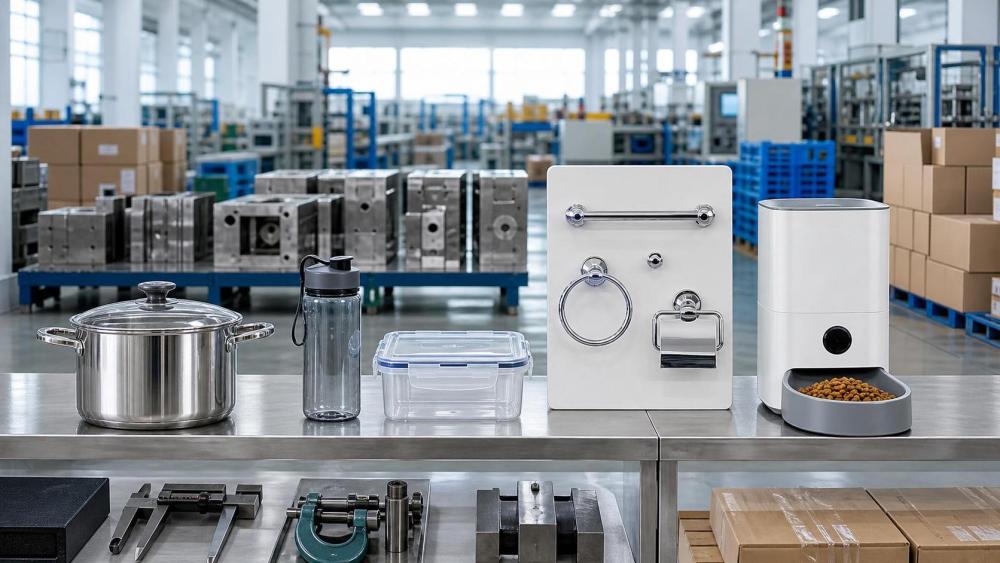
Private label housewares manufacturing looks simple from the outside, but cost is created in many small layers.
A stainless steel pan, Tritan bottle, PP storage box, shower fitting, or smart pet feeder can all sit under one sourcing plan, yet their cost logic differs sharply.
That is why early price comparisons often mislead.
In practical sourcing work, the real question is not only “What is the unit price?” but “What is creating that unit price?”
Materials, tooling, labor, compliance, packaging, and shipping all shape margin and risk.
A lower quote may come from thinner steel, fewer insulation steps, lower polish standards, simplified packaging, or missing test costs.
For private label housewares manufacturing, this matters most when building long-term assortments instead of one-off orders.
CHHS often frames this topic through product systems rather than isolated items.
That approach is useful because cookware, drinkware, sanitary hardware, plastic housewares, and smart pet products each carry different technical cost drivers.
Understanding those drivers makes supplier evaluation more accurate and negotiation more grounded.
What usually makes up the biggest share of manufacturing cost?
In most private label housewares manufacturing programs, raw materials and process complexity account for the largest share.
But the mix changes by category.
For stainless steel cookware, the alloy grade, body thickness, ply structure, handle construction, and finishing standard heavily influence cost.
A tri-ply pan with tight flatness control costs more than a basic single-wall item for obvious process reasons.
For insulated drinkware, steel grade, vacuum performance, copper coating, lid assembly, and leak-proof tolerance can shift cost quickly.
For injection-molded products, resin type, mold cavitation, cycle time, shrinkage control, and cosmetic standards are central.
A food-grade PP container and a clear Tritan bottle may look comparable on shelf, yet their material and molding economics are different.
Bathroom hardware adds another layer.
Brass content, cartridge quality, plating thickness, thermostatic valve structure, and water-control testing all add cost beyond visible appearance.
Smart pet devices bring in electronics, sensors, motor reliability, firmware stability, and after-sales failure risk.
A quick working rule is useful here:
- Material-driven categories: cookware, drinkware, sanitary fittings.
- Tooling-driven categories: molded storage, plastic kitchen tools, silicone accessories.
- Assembly-driven categories: smart bathroom hardware, pet technology, multi-part dispensers.
When reviewing quotes, it helps to separate visible cost from hidden process cost.
How should tooling and development cost be judged before launch?
This is where many private label housewares manufacturing projects go off track.
An attractive unit price can hide a heavy upfront investment in molds, prototypes, fixtures, testing samples, and packaging setup.
For a simple stocked item, development cost may be limited.
For custom geometry, color matching, branded lids, special handles, or new electronic modules, the number rises fast.
Injection-molded housewares are especially sensitive to this issue.
A mold with more cavities lowers unit cost later, but requires higher initial spending.
Tool steel quality, hot runner choice, expected mold life, and maintenance plan should be checked early.
Metal housewares have different development risks.
Draw dies, welding jigs, polishing fixtures, and gauge tools may not look expensive line by line, but together they affect launch cost and consistency.
A useful comparison table can keep evaluation realistic.
More common than expected, a quote excludes one or more of these lines.
Where do quality and compliance costs show up in real sourcing?
Quality cost is rarely just inspection labor.
In private label housewares manufacturing, quality is built into design choices, process controls, testing frequency, and acceptable defect thresholds.
Take food-contact products as an example.
A container, mug, utensil, or silicone tool may require FDA or LFGB-related testing, depending on market and positioning.
That testing cost is not always large per unit, but it becomes significant when repeated across SKUs, colors, or material changes.
For sanitary hardware, corrosion resistance, plating adhesion, flow performance, and valve life testing can increase evaluation cost before volume orders begin.
For smart products, the cost goes beyond compliance paperwork.
Failure analysis, software debugging, battery transport rules, and replacement rates must be considered as part of landed cost.
CHHS frequently highlights this wider view of compliance because technical performance and certification readiness are linked.
If a supplier offers a low price but cannot show stable material traceability or repeatable test history, the quote is incomplete.
A practical review list includes:
- Whether test cost is included per item, per material, or per project.
- Whether packaging and labels meet destination rules.
- Whether production records support repeat orders without rework.
- Whether cosmetic standards match the intended retail tier.
Is logistics a minor cost, or does it reshape the whole quote?
For many housewares categories, logistics can reshape profitability more than expected.
Bulky but low-value items such as storage bins, plastic organizers, and some pet accessories are freight-sensitive.
Dense stainless steel cookware can absorb freight better, but weight still matters.
Vacuum bottles, bathroom hardware, and boxed gift sets often create a packaging-versus-carton-efficiency tradeoff.
In private label housewares manufacturing, the landed cost picture should include more than factory gate price.
Carton dimensions, pallet fit, inner pack quantity, damage rate, and customs classification all matter.
A decorative package may improve shelf impact, yet reduce container utilization enough to offset margin gains.
This is also where supplier engineering capability becomes valuable.
A factory that can redesign inserts, nesting structure, or handle orientation may lower transport cost without changing product function.
When comparing offers, these questions usually reveal the true difference:
- How many units fit in a carton and a container?
- What is the estimated breakage or scratch rate in transit?
- Can packaging be simplified without weakening compliance or presentation?
- Does the product ship assembled, nested, or knock-down?
How can one quote be lower, yet still become the more expensive option?
This happens when low quoted cost creates downstream loss.
In private label housewares manufacturing, the biggest traps are usually hidden in defect handling, unstable materials, repeated testing, packaging claims, and delivery inconsistency.
A cheaper drinkware supplier may miss thermal performance targets.
A cheaper plastic supplier may show color variation or warpage in later batches.
A cheaper hardware source may rely on short-life cartridges or thinner plating.
The result is not only returns.
It can mean delayed launches, repacking, replacement orders, markdown pressure, and extra inspection work.
A better way to judge quotes is to compare total commercial fit, not just ex-factory price.
That means checking technical readiness, category experience, documentation depth, and the supplier’s ability to scale without process drift.
CHHS content is useful here because it links materials, production methods, compliance, and market expectations into one decision view.
That kind of integrated review is usually what separates a workable quote from a risky one.
What is the best next step when evaluating private label housewares manufacturing cost?
Start by breaking the product line into technical families.
Cookware, insulated drinkware, molded storage, sanitary hardware, and smart pet devices should not be judged with one cost template.
Then build a side-by-side cost map covering materials, process steps, tooling, compliance, packaging, and logistics.
That makes negotiation more precise because each price difference can be tied to a real driver.
The strongest sourcing decisions usually come from three checks.
- Confirm what is included in the quote and what remains outside it.
- Match technical requirements to the supplier’s proven production system.
- Estimate landed cost together with failure risk, not separately.
Private label housewares manufacturing becomes easier to manage when cost is treated as a structured decision, not a single number.
A disciplined review of tooling, materials, compliance, and freight will usually reveal which offer supports margin, stability, and long-term category growth.
Recommended News