
Industry News
Curation by industry experts
Hot Articles
Popular Tags
How custom drinkware design choices affect injection mold costs
A distinctive bottle lid, carry handle, or drinking spout can make a product easier to sell—and make its tooling quote harder to explain. When two suppliers price the same concept differently, the gap may reflect different assumptions about mold actions, cavity count, surface finish, or acceptance criteria rather than a difference in manufacturing capability.
Custom drinkware design raises injection mold costs most when it complicates part release, cooling, precision, or assembly. Undercuts and internal threads may require moving mechanisms; tight sealing tolerances demand more controlled tooling; cosmetic finishes add machining and validation work. The practical starting point is to separate features essential to drinking performance from features that can be simplified without weakening the product.
Define which drinkware components actually need injection molds
For a vacuum-insulated stainless steel bottle, the metal body is not normally injection molded. Injection tooling usually applies to the lid shell, threaded insert, flip cover, handle, straw adapter, and other plastic components. A reusable plastic bottle may also require a different molding process for its body, depending on its material and geometry. Silicone seals can involve separate tooling and processing.
This distinction matters when reviewing a quote described simply as “bottle tooling.” Ask for a component-level breakdown showing the manufacturing process, material, number of molds, and cavities per mold. Otherwise, a low headline figure may exclude the closure insert, gasket tooling, assembly fixtures, or later modifications needed to achieve leak resistance.
Also establish whether the project requires a completely new closure or only a customized exterior around an existing interface. Keeping a proven neck finish and sealing arrangement can reduce development uncertainty, provided compatibility, ownership, and supply continuity are confirmed.
The geometry choices that change the mold architecture
A small styling change can move a component from a straightforward opening-and-closing mold to one with slides, lifters, or an unscrewing mechanism. These additions require space, precision fitting, actuation, and maintenance. Their impact is not proportional to how visible the feature is on the finished bottle.
Internal threads deserve particular attention. Some closures can be stripped from the core because their material and thread form allow controlled deformation. Others need mechanical release. Neither approach should be assumed from a rendering: ask the supplier to explain the release method against the actual CAD geometry and selected resin.
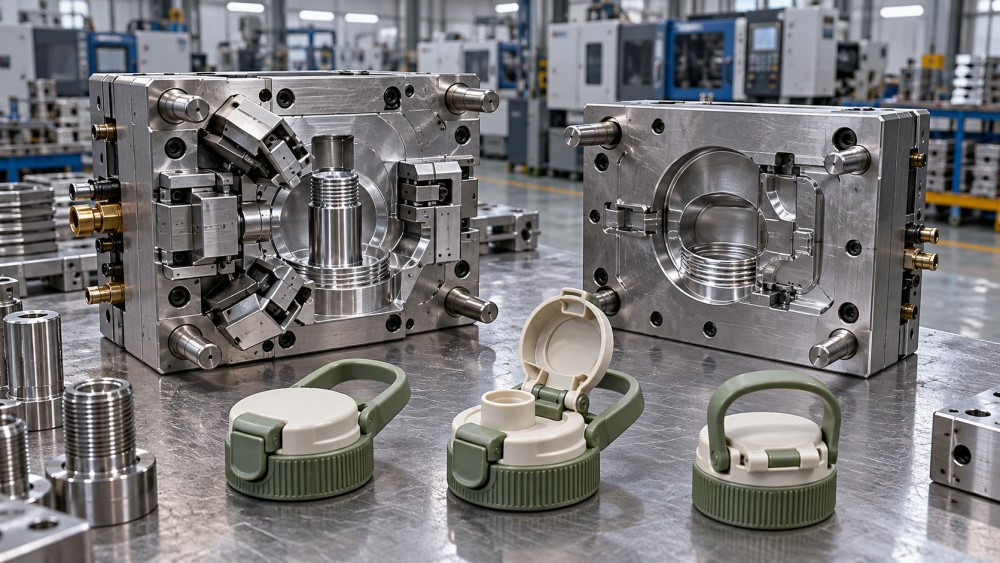
Undercuts are not automatically bad design. A latch may be essential to one-handed operation or secure transport. The useful comparison is between workable alternatives: retain the latch and pay for its mechanism, change its geometry, or create a separate component. Removing an undercut only to add unreliable assembly is not a meaningful saving.
Wall thickness and draft affect more than mold machining
Heavy sections around handles, hinges, and screw bosses cool differently from adjacent thin walls. They can produce sink marks, distortion, or longer cycles. Suppliers may respond with more elaborate cooling, additional mold trials, or concessions on cosmetic acceptance. A lower tooling quote that assumes visible sink marks is not equivalent to one that promises a smooth exterior.
Ask for a wall-thickness review before tool construction. Coring out thick regions and using appropriately designed ribs can improve manufacturability, but rib placement must account for appearance and cleaning access. Internal features that trap liquid or residue should not be introduced merely to simplify molding.
Draft—the taper that helps a part release—also needs agreement early. Deep walls and textured surfaces generally need more release allowance than shallow, smooth features. Insufficient draft can cause scuffing, sticking, or ejection damage. Changes made after steel cutting may alter both appearance and mating dimensions, so draft should be visible in the approved manufacturing design, not left as an undocumented supplier adjustment.
Spend precision on sealing interfaces, not every dimension
A lid can look correct and still leak because the bottle neck, closure, and gasket do not work together. Sealing depends on their combined dimensional variation, gasket compression, contact geometry, and deformation during use. Applying a tight tolerance to every dimension increases inspection and tooling demands without necessarily improving that system.
Identify functional dimensions separately from cosmetic dimensions. Thread engagement, sealing-land geometry, gasket retention, and latch alignment deserve explicit review. Non-mating exterior contours may accept wider variation, subject to agreed appearance requirements.
A useful drawing package specifies:
- The mating bottle-neck geometry and its permitted variation.
- The dimensions and reference surfaces that control seal compression.
- Where flash, gate vestiges, and parting-line mismatch are unacceptable.
- The assembled leak-test conditions and dimensional inspection method.
Do not accept “leakproof” as a substitute for test criteria. Orientation, liquid temperature, pressure conditions, closure method, and conditioning can change the result. Agree on conditions relevant to intended use, then establish which failures require tooling correction and which indicate a material, assembly, or interface problem.
Resin and surface finish change the work behind the quote
Material selection influences shrinkage, stiffness, flow, cooling, and release behavior. PP, copolyester, and other drinkware plastics are not interchangeable tooling inputs. Even grades within a material family can behave differently. The mold should be designed around the intended production grade, rather than a vague description such as “food-grade plastic.”
Changing resin after tooling approval can affect dimensions and processing enough to require modification and renewed trials. Confirm the material grade, colorant system, intended exposure conditions, and applicable food-contact documentation before finalizing shrinkage allowances. A material designation alone does not establish that the finished article meets every destination market requirement.
Transparent and textured parts need different acceptance rules
A clear lid exposes flow marks, weld lines, scratches, and other defects that an opaque component may hide. Optical appearance can require higher polishing quality and more careful gate placement. Ask which surfaces are cosmetic, what defects are acceptable, and how inspection will be performed; “high polish” is too imprecise for comparing offers.
Texture can conceal minor surface variation, but it adds surface-treatment work and may increase draft requirements. It can also be difficult to reproduce consistently after local repairs. Place texture boundaries, logos, and polished windows on the drawing. Where future branding changes are likely, replaceable logo inserts may be worth pricing, although their fit and witness lines need acceptance limits.
Cavity count: lower unit cost can mean higher upfront exposure
A multi-cavity mold produces more parts per cycle, but requires more repeated tooling detail and a suitable molding machine. Runner layout, cooling, cavity balance, and maintenance all become part of the investment. More cavities do not guarantee proportionally greater usable output if cycle time increases or some cavities produce unacceptable parts.
For an uncertain launch, a lower-cavity tool may reduce committed capital. A high-volume program may justify more cavities when supported by demand, machine availability, and demonstrated process capability. Request capacity estimates based on cycle time, operating hours, and expected usable output—not cavity count alone.
A family mold, which makes different components in one tool, can reduce the number of molds. However, components with different volumes or cooling needs may be difficult to balance. Replacement-part demand can also leave unwanted companion parts in inventory. Ask suppliers to compare separate molds and a family mold against the actual assembly ratio and forecast.
Compare tooling routes using total program cost
The lowest initial quote may use a different steel specification, runner system, mechanism, or service-life assumption. Those differences can be reasonable for a short production run but unsuitable for recurring replenishment. Specify the expected production horizon and ask suppliers to state the basis for their tool-life and maintenance commitments.
Cold-runner tooling can offer a simpler initial setup, while hot-runner systems add components and controls that may reduce runner waste and suit some production requirements. The choice depends on resin, shot size, color changes, cavity layout, and operating support. Do not assume runner material can always be reused in food-contact parts; permitted reprocessing needs material, quality, and compliance review.
Use a consistent comparison:
Program cost = tooling and validation + purchased-part cost over expected volume + maintenance, changes, and replacement exposure.
Keep the accounting consistent. If the piece price already includes resin, conversion, and supplier scrap allowances, do not add those costs again. Run the comparison at a conservative forecast as well as the planned volume, especially where a more expensive mold depends on strong sales to recover its premium.
Turn the design review into a comparable RFQ
Before requesting a final price, issue the same CAD revision, resin specification, finish requirements, forecast, and acceptance criteria to every supplier. A quote based on a rendering is useful for budgeting, but it cannot reliably establish the cost of an unresolved closure mechanism.
- Request a manufacturability review. Have suppliers identify undercuts, proposed parting lines, gate positions, ejection points, draft changes, and sealing risks.
- Separate baseline and optional features. Price the essential closure first, then identify the incremental tooling and unit-cost effects of the handle, texture, decorative insert, or soft-touch grip.
- Make tooling assumptions explicit. Record cavities, steel specifications, runner system, expected cycle time, press requirements, and included trials.
- Define correction responsibility. Distinguish supplier corrections needed to meet approved requirements from buyer-requested design changes.
- Document ownership and access. Confirm mold identification, storage, maintenance records, transfer conditions, and access to necessary technical information.
Reserve final cosmetic texturing until dimensions and function are sufficiently validated, since later steel changes can damage the finish. For revisions, ask whether the affected feature uses a replaceable insert and what revalidation is required.
The strongest cost-reduction proposal identifies a specific trade-off: removing a slide by changing an opening, keeping a standard sealing interface beneath a custom exterior, or relaxing a nonfunctional tolerance. Require each proposal to show its effect on tooling, piece price, assembly, and acceptance. That makes design simplification a purchasing decision grounded in product performance rather than a general request for a cheaper mold.
Recommended News