
Industry News
Curation by industry experts
Hot Articles
Popular Tags
How to verify food contact safety with migration testing
How can quality control and safety teams verify that food-contact products are suitable for their intended use? Migration testing provides evidence by measuring substances that may transfer from materials into food or food simulants under specified conditions. For cookware, drinkware, plastic containers, and other housewares, the right test plan depends on the material, the way the product will be used, and the requirements of its destination market. A useful report does more than say “pass”: it shows what was tested, why those conditions were selected, and which safety questions remain open.
What migration testing can—and cannot—verify
Migration is the transfer of substances from a food-contact material into food. Potential migrants include components of the material itself, additives, residual manufacturing substances, breakdown products, and substances introduced through inks, adhesives, coatings, or contamination. Transfer can vary with temperature, contact time, food composition, and the condition of the contact surface.
Laboratories often use food simulants rather than actual foods. These are selected to represent relevant food characteristics, such as acidity, water content, alcohol content, or fatty properties. A sample is exposed to a specified simulant under controlled conditions, and the resulting extract is analyzed. Actual food testing may also be appropriate or required in particular circumstances.
Two types of measurement commonly appear in test plans:
- Overall migration measures the total amount of non-volatile substances transferred under the test conditions. It is especially relevant to plastics under the applicable EU rules, but does not identify every migrant or establish the toxicity of the mixture.
- Specific migration measures a named substance or group of substances against an applicable limit or other assessment criterion. The analytical method must be suitable for the substance and the relevant simulant.
A passing result is therefore evidence for the tested sample and conditions—not proof that every unit, every food type, and every future use is safe. Migration testing should sit alongside formulation review, manufacturing controls, supplier documentation, and a review of the applicable legal framework.
Build the test plan around the real product
The most important work often happens before a sample reaches the laboratory. A quality manager evaluating a storage box, for example, needs to know whether it will be used for cold leftovers, reheated meals, or both. The same polymer and container design can require different assessments when the intended conditions change.
Start with a product-use description that the laboratory can act on:
- Identify the market and product category. Specify where the finished product will be sold and whether it is cookware, a bottle, a reusable container, or another article.
- Map every food-contact component. Include lids, seals, valves, linings, dispensing surfaces, and other parts that can contact food or beverage during normal and reasonably foreseeable use.
- Describe contact conditions. Record food types, maximum temperature, expected duration, repeated use, washing, reheating, and any claim such as microwave or oven suitability.
- Collect material and process information. Request composition and supplier declarations for resins, additives, colorants, coatings, and other relevant inputs, subject to appropriate confidentiality controls.
- Agree on the analytical scope. Select relevant simulants, exposure conditions, overall or specific migration tests, and reporting limits against the applicable requirements.
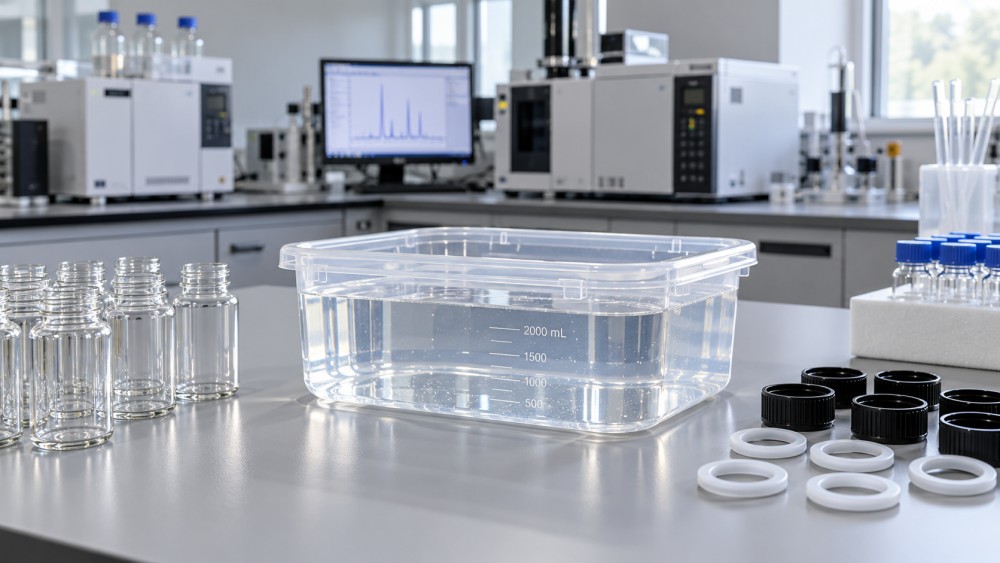
Surface-area-to-volume assumptions matter. A small silicone seal in a large bottle and a shallow food container may have different contact relationships. Ask the laboratory to explain whether the result is expressed per unit of contact area, per mass of food or simulant, or in another form, and how the conversion relates to the applicable rule. Do not compare results with a limit expressed in different units without a justified calculation.
Match exposure to foreseeable use
Test conditions should represent the intended use or an appropriate, legally specified worst case. Hot-fill bottles, for example, should not be assessed only for brief contact with cold water if the product is marketed for hot beverages. A container intended for fatty foods needs an assessment that covers that use, rather than relying solely on a water-based simulant.
More severe is not always more meaningful. An unnecessarily aggressive exposure may damage a material in a way that does not reflect its intended use, while a mild exposure can miss a relevant risk. Where legislation or a recognized method defines standardized conditions, use those provisions rather than choosing temperature and time by intuition.
Repeated-use articles deserve particular attention. Some regulatory methods require successive migration tests and specify which result is used for compliance assessment. Agree on the preparation, number of contacts, and interpretation before testing; a single exposure may not answer the question for a reusable bottle or food container.
Choose requirements by market, not by label alone
“Food grade” is a useful description in a purchasing conversation, but it is not a complete compliance criterion. A QC team needs to identify the applicable legislation, material-specific rules, and evidence required for the particular product and market.
In the European Union, Regulation (EC) No 1935/2004 provides the general framework for food-contact materials, including the requirement that materials do not transfer constituents in quantities that could endanger health, unacceptably change food composition, or deteriorate its characteristics. Regulation (EC) No 2023/2006 addresses good manufacturing practice. For plastics, Regulation (EU) No 10/2011 sets material-specific requirements, including authorized substances, restrictions, and migration testing rules. Check the consolidated legislation and applicable amendments when preparing a plan.
In the United States, food-contact compliance depends on the applicable authorization and conditions of use under the Federal Food, Drug, and Cosmetic Act and relevant FDA regulations or other applicable authorizations. A material’s status cannot be established simply by applying EU migration limits. Composition, temperature, food type, and use conditions must be checked against the relevant authorization; migration data may support the assessment where appropriate.
For Germany, LFGB requirements and relevant material-specific recommendations or methods may be part of a buyer’s specification. The appropriate assessment depends on the material and legal context. An “LFGB test” is not one universal test covering every product and substance, so the report should identify the actual methods and criteria applied.
Other destination markets can impose their own requirements. Confirm the current rules with a qualified laboratory or regulatory specialist, particularly when a product combines several materials or is sold across jurisdictions.
Material details that change the testing conversation
Plastic containers and bottles: Polymer identity is a starting point, not the whole assessment. Additives, pigments, processing aids, recycled content, and manufacturing changes can affect the substances requiring review. For a polypropylene storage container or a transparent copolyester bottle, obtain information about the complete formulation where possible and align simulants with the claimed food uses. A resin supplier’s declaration may support the file, but it does not automatically cover the finished article’s colorants, printing, or processing.
Stainless steel cookware and drinkware: The alloy grade and manufacturing specification matter, as do welds, surface finishes, and the food-contact environment. A double-wall insulated mug may also contain a plastic lid, silicone gasket, coating, or printed component. Assess the parts that can actually contact the beverage; do not assume that a claim about the steel grade covers the entire assembly. Where relevant requirements or risk assessments call for metal release testing, select the method and acceptance criteria for the destination market and intended use.
Silicone kitchenware and seals: Review the formulation, curing process, and intended temperature range. Volatile or extractable substances may warrant attention depending on the applicable method and risk assessment. A seal used in a hot-drink lid should be considered under conditions representative of hot beverage contact, not treated as a minor component merely because it is small.
Coatings, inks, and adhesives: These may be present in multilayer constructions or near food-contact areas. Even where a layer is not intended to touch food directly, transfer through or around a barrier can be relevant. The test strategy should reflect the construction and the evidence available for the barrier, rather than assuming that an exterior layer can never contribute to migration.
Read the laboratory report like an investigator
A report becomes decision-ready only when its scope matches the product specification. Before accepting a pass statement, compare the tested sample with the item being purchased or released. Check the product identifier, material and color, contact surfaces, preparation, simulants, exposure time and temperature, analytical methods, results, units, applicable limits, and any stated exclusions.
Pay attention to the limit of quantification. A “not detected” result means the substance was not detected at the method’s stated sensitivity; it does not prove absolute absence. The reporting limit must be suitable for evaluating the relevant restriction. Also check whether the laboratory has identified deviations, assumptions, or uncertainty that could affect interpretation.
If a report covers a component rather than the assembled product, determine whether that component-level evidence is sufficient for the decision. Testing a resin plaque, for example, may not capture changes caused by molding, a different colorant, or contact with another component. Conversely, a finished-product result without reliable material information may leave questions about untested substances.
Where a result exceeds an applicable limit, avoid treating the issue as a paperwork problem. Quarantine affected stock as appropriate, confirm sample identity and calculations, review the method and test conditions, and investigate formulation or process changes. Retesting can be useful when justified, but it should not be used to select a favorable result while ignoring a credible failure. Document the technical basis for disposition and any corrective action.
Keep the evidence valid after approval
A migration test is a snapshot. Food contact safety management requires a way to decide when that snapshot no longer represents production. Establish change controls for material suppliers, resin grades, additives, pigments, recycled inputs, molds, coatings, processing conditions, and product claims. A change from cold storage to microwave use, for instance, can alter the relevant exposure even when the container looks identical.
Link each report to a controlled product specification and retain the supporting declarations, test plan, sample details, results, and approval decision. Set a review schedule based on risk, production history, buyer requirements, and regulatory changes; there is no single retest interval that suits every product.
For procurement and quality teams, the practical goal is traceability: being able to explain why a particular combination of materials, uses, and test conditions supports the release decision. When the evidence is specific enough to answer that question—and current enough to reflect what is actually being made—migration testing becomes a meaningful part of food-contact compliance rather than a certificate filed away after launch.
- Last One:No more articles
- Next Article:What documents should suppliers provide for food-contact compliance?Oct 29, 2026
Recommended News