
Industry News
Curation by industry experts
Hot Articles
Popular Tags
Food-Grade Silicone Bakeware: LFGB vs FDA Safety Differences
Why does the LFGB vs FDA question matter for food-grade silicone bakeware?
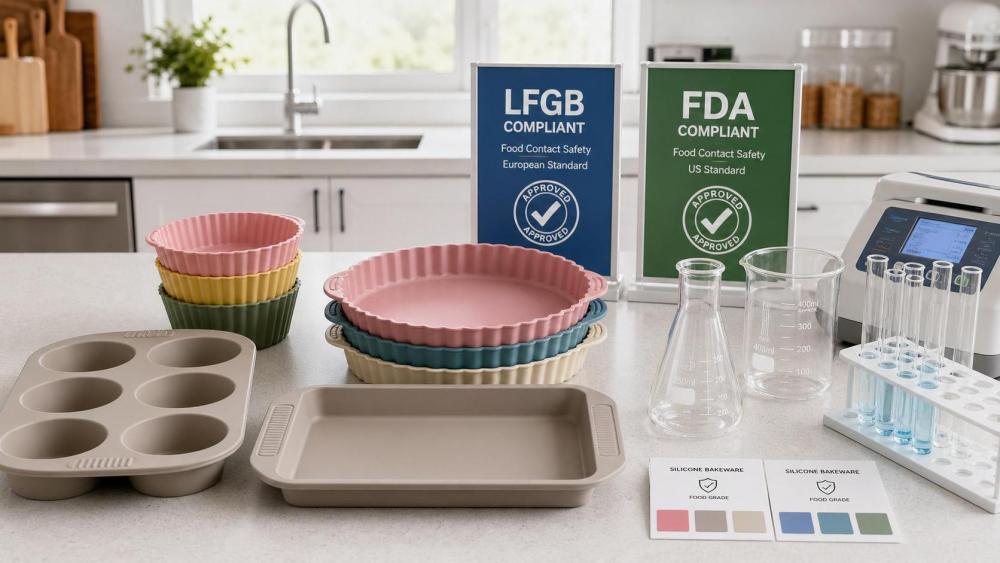
Food-grade silicone bakeware often looks similar across suppliers, but its compliance path can be very different.
That is why the LFGB vs FDA comparison keeps appearing in audits, supplier reviews, and product approval discussions.
In simple terms, both frameworks address food-contact safety, yet they do not ask the same questions in the same way.
For food-grade silicone bakeware, that difference affects testing scope, market fit, documentation, and sometimes formulation choices.
A tray, muffin mold, or spatula holder marketed into Europe may face stronger scrutiny under LFGB-related expectations.
A similar item entering the United States is usually evaluated against FDA food-contact requirements and supporting declarations.
The practical issue is not deciding which standard is “better” in the abstract.
The real issue is whether the selected food-grade silicone bakeware can pass the right tests for the right market without late-stage surprises.
Across housewares supply chains, compliance decisions increasingly sit beside durability, odor control, heat resistance, and retail claim accuracy.
That broader view is common in CHHS coverage, where material safety and sourcing decisions are treated as part of product performance.
When people say LFGB and FDA, are they talking about the same kind of safety standard?
Not exactly. The two are related in purpose, but different in structure and testing logic.
FDA usually refers to U.S. food-contact regulations and material suitability under the Code of Federal Regulations.
LFGB refers to the German food and feed code framework, commonly used as a demanding benchmark for food-contact articles.
In day-to-day sourcing language, people often treat FDA as a baseline market-access reference and LFGB as a stricter product-screening benchmark.
That shorthand is useful, but it can oversimplify the decision.
For food-grade silicone bakeware, the difference often shows up in migration testing, odor and taste evaluation, and extractable substances.
Some silicone compounds can satisfy FDA expectations but still struggle with LFGB-style sensory or migration requirements.
This explains why a supplier certificate saying “FDA silicone” does not automatically mean “LFGB passed.”
A clearer way to understand the gap is to look at the decision factors side by side.
The table does not replace a legal review, but it helps frame the right technical questions early.
What are the real safety differences in food-grade silicone bakeware testing?
The biggest difference is not the word on the certificate. It is the testing behavior behind that word.
FDA-related compliance usually starts from whether the silicone formulation is suitable for food-contact use under applicable U.S. rules.
LFGB testing is often approached more through the finished article and its actual release behavior under test conditions.
For food-grade silicone bakeware, this matters because curing quality, fillers, pigments, and post-processing can alter final results.
A technically acceptable raw material can still produce weak finished-product outcomes if the process is unstable.
Common checkpoints include overall migration, volatile residues, peroxide byproducts, odor transfer, and taste transfer.
Heat exposure also matters because bakeware faces repeated oven cycles, not just ambient kitchen storage.
In actual factory reviews, the safety discussion often overlaps with process control questions.
- Was the silicone fully cured, or is residual odor still present?
- Are colorants and additives documented for food-contact use?
- Does the same formulation run across all cavity designs and thicknesses?
- Were tests performed on the final product, not only the compound?
That is why food-grade silicone bakeware should be treated as a process-controlled article, not just a raw material category.
If a supplier says “FDA silicone,” what still needs to be checked?
Quite a lot. “FDA silicone” is one of the most overused phrases in silicone kitchenware sourcing.
Sometimes it means the base polymer is food-contact suitable. Sometimes it only means the supplier has an old report on file.
Neither point is enough by itself for food-grade silicone bakeware approval.
A better approach is to verify the claim through product-level evidence and batch traceability.
The most useful documents are recent, product-specific, and connected to the exact formulation and factory process.
Needlepoint detail matters here. A loaf pan with dark pigment and thick walls can behave differently from a thin pastel cupcake mold.
Before accepting a claim on food-grade silicone bakeware, confirm these points:
- The report names the actual product or material code.
- The test laboratory is identifiable and current.
- The report covers intended temperature and contact conditions.
- The declaration matches the same production site used for shipment.
- Any claim for LFGB is supported separately, not assumed from FDA.
In practical sourcing systems, this is where many preventable nonconformities begin or end.
CHHS often follows this kind of issue across housewares categories because compliance claims frequently move faster than evidence quality.
Which standard makes more sense for different markets and applications?
The answer depends on where the food-grade silicone bakeware will be sold, how it will be used, and how much compliance buffer is needed.
If the target market is mainly the United States, FDA-aligned documentation may be the first gate.
If the product is aimed at Germany or EU buyers with stricter screening habits, LFGB evidence may carry more weight.
For international programs, many teams prefer the higher-confidence route of testing against tougher expectations early.
That does not always mean every item needs every test.
More commonly, the right move is to map product families by risk and market exposure.
In other words, the better question is not only “LFGB or FDA?”
It is “Which evidence package reduces approval risk for this exact launch plan?”
Where do teams usually misjudge food-grade silicone bakeware compliance?
One frequent mistake is assuming food-grade silicone bakeware is inherently safe because silicone has a good reputation.
Base material reputation does not replace finished-product verification.
Another mistake is treating test reports as permanent assets. They are not.
A pigment change, mold release adjustment, curing shift, or subcontracted production transfer can invalidate old assumptions.
The third weak point is incomplete use-condition definition.
Bakeware faces high temperatures, repeated cycles, oily recipes, dishwasher exposure, and sometimes freezer-to-oven transitions.
If the test plan does not reflect that profile, the result may look compliant but still miss real-use risk.
There is also a commercial misconception worth addressing.
Passing LFGB may support stronger confidence, but it does not automatically prove superior durability, better anti-stick behavior, or longer service life.
Those characteristics still depend on design thickness, reinforcement, curing discipline, and thermal cycling performance.
What is a practical next step before approving a silicone bakeware program?
Start by defining the market path and the actual use profile of the food-grade silicone bakeware.
That single step often clears up whether FDA documentation is enough or LFGB-level testing should be added.
Then review the product as a complete compliance package, not as an isolated lab report.
- Match each SKU to its target country and retail channel.
- Check whether the report reflects the final color, shape, and curing process.
- Set retest triggers for formulation, tooling, or site changes.
- Keep declarations, lab reports, and production records linked by batch logic.
For food-grade silicone bakeware, the LFGB vs FDA decision is really a control question.
Which framework best matches the market, and which evidence best supports repeatable safety in production?
Once that is clear, certification review becomes faster, supplier discussions become sharper, and launch risk drops noticeably.
The most reliable path is to compare standards early, test the final article, and treat compliance as part of product engineering rather than paperwork alone.
Recommended News