
Industry News
Curation by industry experts
Hot Articles
Popular Tags
FDA Approved Houseware: Common Claims and Hidden Risks
FDA Approved Houseware: Common Claims and Hidden Risks
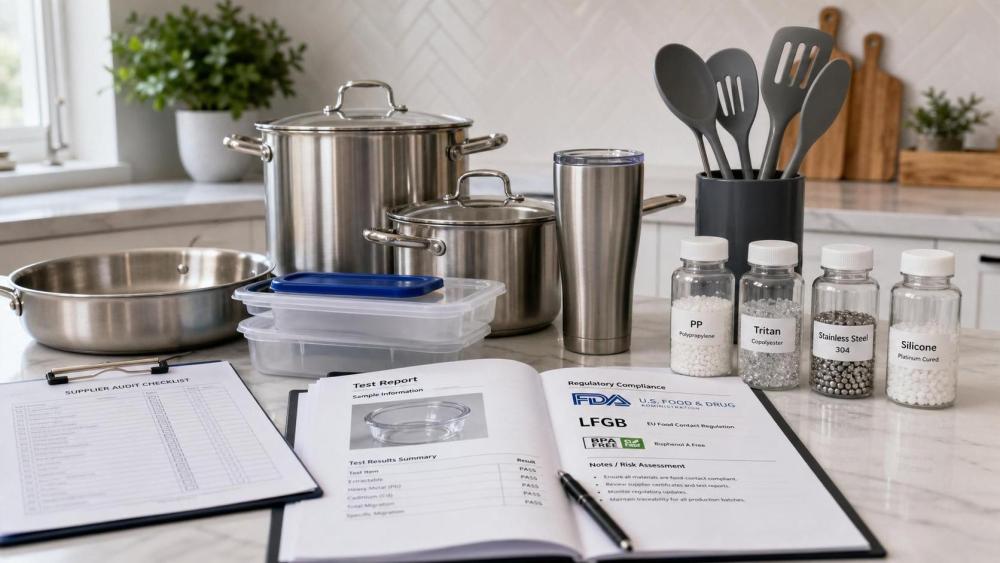
FDA approved houseware sounds reassuring at first glance. In real sourcing work, it often raises more questions than it answers.
Many suppliers use the phrase to suggest safety, legality, and market readiness. But FDA approved houseware is not a formal approval category for most everyday products.
That gap creates room for confusion. It also creates risk during supplier screening, label review, and retail compliance checks.
The issue matters across cookware, drinkware, food storage, silicone tools, plastic containers, and kitchen accessories. These products frequently contact food, heat, water, oils, or acidic ingredients.
From a business perspective, the real question is not whether a product is called FDA approved houseware. The real question is whether its materials, process, and claims hold up under review.
This article breaks down what the term usually means, where it is commonly used, and where hidden exposure tends to appear.
What “FDA Approved Houseware” Usually Means
In most cases, FDA approved houseware is marketing shorthand. It usually points to food-contact material compliance, not direct FDA product approval.
That distinction is important. The FDA regulates food-contact substances and applicable safety frameworks, but it does not broadly “approve” common housewares one by one.
So when a supplier says FDA approved houseware, they may actually mean one of several different things.
- The material is intended for food contact.
- A resin or additive references FDA regulations.
- The factory has a migration test report.
- The item was made using food-grade inputs.
- The seller is using an oversimplified export phrase.
In actual due diligence, those statements are not equal. Some are meaningful. Some are incomplete. Some are simply inaccurate.
A better working phrase is “complies with applicable FDA food-contact requirements.” It is narrower, but much more useful.
Which Products Commonly Use the Claim
The FDA approved houseware claim appears most often in products with direct or repeated food contact. It is especially common in online catalogs and export quotations.
Typical categories include:
- Stainless steel cookware, mixing bowls, and kitchen tools
- Insulated bottles, mugs, tumblers, and thermos products
- PP food containers, Tritan bottles, and lunch boxes
- Silicone spatulas, baking mats, lids, and baby-feeding accessories
- Chef knives, cutting boards, and utensil handles
More recently, the phrase also appears in smart drinkware, pet feeders, and water-contact components. That trend reflects broader demand for material safety signaling.
Still, product category alone does not validate the claim. The actual compliance burden depends on material type, temperature exposure, use pattern, and formulation details.
Why the Claim Can Be Misleading
The biggest problem with FDA approved houseware is that it compresses a technical issue into a simple label. Buyers then assume the whole product has been fully cleared.
In practice, compliance is often component-based. A lid gasket, colorant, coating, adhesive, or printed decoration may create the real risk.
This is where hidden gaps appear. A bottle body may be fine, while the straw material fails. A steel pan may be stable, while its nonstick layer lacks documentation.
Another common issue is outdated evidence. A supplier may present a report for raw material pellets, not for the finished item now entering the market.
The wording also causes retail risk. Marketplaces, import teams, and legal reviewers may challenge “FDA approved” if the statement overreaches.
That means the phrase can create a short-term marketing advantage, but a longer-term documentation problem.
Hidden Risks Behind FDA Approved Houseware Claims
The risks usually do not sit in the headline claim itself. They sit in the missing details behind it.
1. Material substitution
Factories may switch resin grades, silicone compounds, pigments, or steel sources. The original paperwork then no longer matches production reality.
2. Partial documentation
Some files only cover one component. Others show general declarations without test conditions, laboratory identity, or product traceability.
3. Use-condition mismatch
Cold-water compliance does not automatically support boiling liquids. Dry-food contact does not automatically support fatty foods or acidic recipes.
4. Decoration and surface treatment risk
Exterior paints, logo inks, metallic coatings, and inner linings can introduce separate risk pathways, especially in insulated drinkware and coated cookware.
5. Claim misuse in marketing
Even when the product is reasonably compliant, the phrase FDA approved houseware may still be too broad for packaging, listings, or buyer-facing documents.
What to Check Before Accepting the Claim
A practical review process helps separate solid suppliers from risky ones. The goal is not more paperwork. The goal is better evidence.
Start with these questions:
- What exact materials touch food or drink?
- Which component suppliers provide those materials?
- What FDA-related regulation or test is being referenced?
- Does the report cover the finished product or only raw material?
- Do the test conditions match the real use case?
- Has the formulation changed since the report date?
This screening step quickly reveals whether FDA approved houseware is being used carefully or casually.
A Simple Evaluation Framework for Sourcing Teams
In real business settings, speed matters. A short framework can improve review quality without slowing down supplier selection.
This kind of table is especially useful when comparing multiple suppliers across cookware, plastic storage, or insulated bottle projects.
Where Risk Is Higher by Product Type
Not all houseware categories carry the same exposure. Some product types deserve deeper review from the start.
- Insulated drinkware: Watch inner lining, solder points, seals, straws, and printed surfaces.
- Nonstick cookware: Check coating systems, curing consistency, and high-temperature use conditions.
- Plastic containers: Review resin grade, recycled content claims, colorants, and microwave-use positioning.
- Silicone kitchenware: Confirm compound quality, filler control, odor issues, and heat-contact suitability.
- Pet feeding products: Treat bowls, fountains, and feeders like food-contact systems, not simple plastic accessories.
From recent market behavior, the stronger signal is not the claim itself. It is how confidently the supplier explains these category-specific details.
How to Use Safer Language in Commercial Documents
If the product has solid evidence, the next step is wording discipline. This helps reduce audit friction and avoid overstatement.
Instead of repeating FDA approved houseware everywhere, use more precise language in quotations, specifications, and listings.
- “Made with food-contact materials intended to comply with applicable FDA requirements”
- “Test reports available for relevant food-contact components”
- “Compliance documents can be provided based on final product configuration”
This approach sounds less flashy, but it is far more defensible. It also supports smoother communication between sales, sourcing, and compliance teams.
Final Takeaway
FDA approved houseware is a familiar phrase, but it should never end the evaluation process. It should start a more precise review.
The most reliable decisions come from matching claims to materials, components, tests, and use conditions. That is where true compliance visibility appears.
In everyday sourcing, better questions usually matter more than bigger promises. That also means better outcomes for imports, retail readiness, and brand credibility.
When reviewing FDA approved houseware, look past the phrase, verify the evidence, and qualify the wording. That is the practical path to lower risk and stronger buying decisions.
Recommended News