
Industry News
Curation by industry experts
Hot Articles
Popular Tags
Does food contact household safety depend on packaging materials?
Does food contact household safety really depend on packaging materials? For quality control and safety managers, the answer goes far beyond labels or appearance. Material composition, migration risk, sealing performance, and compliance with food-contact standards all influence whether household packaging protects consumers or creates hidden hazards. Understanding these factors is essential for evaluating suppliers, reducing product risk, and ensuring consistent safety across global markets.
In household products, “packaging” is often interpreted too narrowly. Many teams think only of the outer bag, carton, or retail wrap. In practice, food-contact household safety is shaped by every layer that may touch food, absorb grease, release substances, or influence storage conditions. That includes storage containers, lids, liners, films, seals, closures, and even printing inks on labels when they are positioned too close to food-contact areas.
For quality and safety personnel, the key question is not whether a material looks clean or modern. It is whether the entire packaging system remains stable under real use: refrigeration, freezing, heating, transport vibration, humidity, and repeated opening and closing. A material that passes a basic appearance check can still fail in migration, odor, deformation, or seal integrity.
Why packaging materials matter in food-contact household products
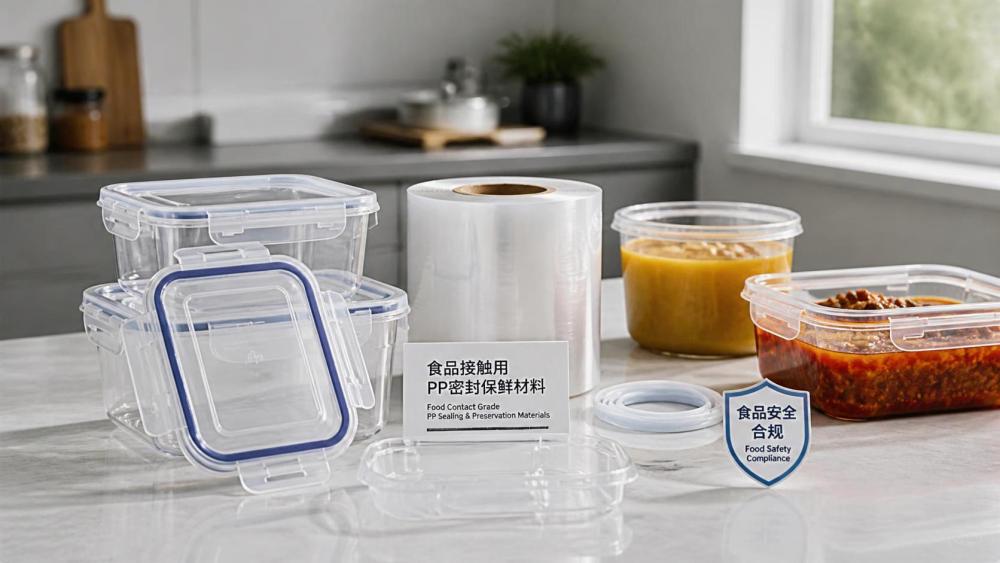
In household applications, packaging materials are part of the product’s safety boundary. A storage box made from food-grade PP, for example, may still create risk if the lid gasket contains non-compliant additives or if the closure system allows contamination during use. The same logic applies to disposable or semi-reusable packaging used for food storage, meal prep, takeaway, and pantry organization.
Safety depends on how the material behaves, not just what it is called. A “food-safe” label does not guarantee compliance across all conditions. Temperature, fat content, acidity, and contact duration can all change migration behavior. For quality teams, this means supplier declarations are only a starting point. Verification must include test conditions that match the actual use case.
The main risk factors quality teams should watch
Migration risk is the most direct concern. Substances can move from packaging materials into food, especially when the product contains oils, spices, acidic ingredients, or is exposed to heat. This is why a container suitable for dry goods may not be suitable for hot soup or microwave reheating.
Additive selection matters just as much as the base polymer. Plasticizers, slip agents, antioxidants, colorants, and processing aids can all influence compliance. In many cases, the resin itself is acceptable, but the formulation is not stable enough for food-contact use.
Seal performance is another hidden issue. If the lid, gasket, closure, or heat-seal layer fails, contamination risk increases even when the material is compliant. Leakage can also create a secondary safety problem by allowing microbial growth during storage or transport.
Odor and taste transfer are often treated as consumer complaints, but they are also quality signals. Strong odor may indicate residual monomers, solvents, poor resin control, or contamination during molding and conversion.
Heat and aging resistance should not be underestimated. Many household packaging products are reused. Repeated dishwashing, UV exposure, and thermal cycling can change the material structure, leading to cracking, warping, or surface degradation. Once that happens, safety assumptions made at the beginning of the product life no longer hold.
Which standards actually matter
For global sourcing, standards are where many misunderstandings begin. Different markets use different test methods and compliance frameworks. For food-contact household safety, teams often need to review FDA-related requirements in the United States, LFGB expectations in Germany and broader EU market practice, and other destination-specific regulations depending on the sale channel. The exact regulatory path must be confirmed by product type and market scope.
What matters operationally is not memorizing every rule, but knowing which questions to ask:
Does the supplier provide a declaration of compliance for the exact material and formulation? Are the test conditions aligned with intended food type, time, and temperature? Is the certification for the base resin only, or for the finished product structure? Do inks, coatings, adhesives, and seals also fall under the tested scope?
These questions are critical because many failures happen at the interface between components. A packaging system may be built from acceptable individual materials but still fail as a finished product if one layer is outside the tested scope.
Common mistakes in supplier evaluation
One common mistake is treating “same material” as “same safety.” Two PP containers can behave very differently if the resin source, filler content, pigment package, or processing temperature differs. Another common error is relying on a single test report for a broad product family. Safety managers should be cautious when a supplier uses one report to cover multiple sizes, colors, or structures without clear technical justification.
Teams also tend to overlook post-processing. Printing, embossing, labeling, ultrasonic welding, and adhesive bonding can all introduce additional risks. If a product is sold as food-contact household packaging, every modification should be reviewed for its impact on compliance.
There is also a procurement-side issue: some suppliers provide attractive claims but cannot maintain lot-to-lot consistency. From a QC perspective, this is often more dangerous than an obvious non-compliance problem, because the product may pass incoming inspection once and fail later in mass production.
How safety managers should evaluate packaging materials in practice
A practical evaluation starts with intended use, not with material marketing. Hot-fill, frozen storage, dry food, oily food, and microwave reheating all create different requirements. If the application is unclear, the compliance result is not reliable.
Then review the full material stack. For a household food container, that means base resin, color masterbatch, lid, gasket, sealing ring, decorative coating, adhesive, and any printed surface that may come into contact with food or vapor. If the supplier cannot identify each component, the risk profile is incomplete.
Testing should reflect actual stress conditions. For example, short-term room-temperature contact is not enough for products intended for hot liquids or repeated washing. Migration tests, sensory checks, and physical durability tests should be aligned with the worst credible use scenario, not the most favorable one.
Documentation matters as much as laboratory results. Batch traceability, raw material declarations, change-control records, and supplier corrective action history all influence whether a material can be trusted in repeated production. A one-time compliant sample does not guarantee continued safety after formula changes or tool adjustments.
The most useful mindset is simple: packaging materials are not just a cost item or design choice. They are a control point in the food safety chain.
What this means for sourcing and compliance decisions
For buyers and quality teams, the decision should not be “plastic or paper,” “cheap or premium,” or even “food-grade or not.” The real question is whether the packaging material can keep its safety performance under the exact conditions of use, distribution, and storage.
That distinction matters in cross-border trade. A product acceptable in one market may require additional documentation, different migration limits, or stricter verification in another. Exporters that understand this early reduce rework, recall exposure, and border clearance risk.
In short, food contact household safety does depend on packaging materials—but only when materials are evaluated as a complete system. The safest products are usually not the ones with the loudest claims. They are the ones with the clearest material definition, the most realistic testing, and the tightest control over change.
Recommended News